Tuesday, October 28, 2008

Frosty morning

I know frost is meant to be the gardener's enemy. I, like no doubt many others in the vicinity, spent much of yesterday running around frantically squirrelling things away in my greenhouse as the weather forecast got gloomier and gloomier. This morning, I still found I had several casualties when I woke up to find it went down to minus 2 or so. But oh... it was so beautiful.


This was one of my casualties - the Nicandra physaloides, now reduced to a sodden mess in the corner. But didn't it look lovely as it died.


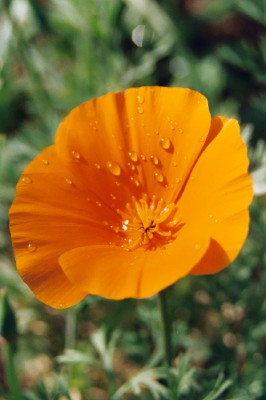
I thought this Goliath poppy was being a bit optimistic, producing flower heads this late in the season!

Verbena bonariensis is, I often think, at its best after a good frost.

The frost melted pretty quickly but even that sent me into rhapsodies - this is Melianthus major which holds onto the droplets like jewels. The little spider was up early, too.


Another one that's looking good as the frost melts off it - this is Eucalyptus gunnii, kept coppiced for that glaucous, rounded young foliage.

And even the nettles were pretty. It doesn't get much better than that.

Thursday, October 23, 2008

Spooky things #3

No, not fungi this time - but another type of plant which has many gardeners feeling pretty uneasy. Including me, though I can't help but be fascinated in a gruesome sort of way.

These little triffids were in the behind-the-scenes glasshouses at Kew, where I went the other day on a press trip (along with EmmaT, though she didn't know it at the time). We got to the glasshouses right at the end of the day, which was a bit of a shame, as they were fascinating - they house some of the rarest plants in the world, some recreated from DNA rescued from the last remaining live bit of the last remaining and otherwise non-viable seed from a plant extinct in the wild. That sort of thing.

Anyway, these aren't that rare, or at least not to the carnivorous plant cognoscenti, but were kicking about on a shelf in the main corridor that runs through the glasshouse. The above is a Nepenthe ampuliaria, a relative pussycat in the carnivorous plant world - merely drowning the odd bluebottle or two for tea.

This, on the other hand, is Nepenthe truncata. Don't stick your fingers in here, whatever you do. Or any other part of your anatomy. That tube is nearly a foot long, and half-filled with digestive juices. This plant eats mice.

As if to prove that these little green monsters do have some horticultural merit, here's a sundew (Drosera) - I didn't get the full plant name, but it's a pretty little thing, isn't it? So long as you don't think about the fact that all those charming droplets are actually stomach juices.

Now, never mind the Hallowe'en-ish feel of this particular post - here's something that's genuinely, bona-fide useful. I think it's Pinguicula x kewensis but don't quote me on that - it didn't have a label that I could find. Anyway, not only does it look approximately like a normal plant even though it's actually carnivorous - it's a handy biological pest control. Kew pop these all over the place in their glasshouses as little whiteflies and red spider mites can't tell the difference between it and something less deadly - so they land on the leaves and are promptly dissolved and digested. Apparently they keep the glasshouses clean of pests without a spray can in sight. And they're pretty, too. If a little scary.

Monday, October 20, 2008

Plant of the month - October

Leucanthemella serotina


What a welcome home. This gorgeous 6-footer daisy is peeking over the beech hedge in my front garden at the moment, waving at me from down the street. You can't help but smile.

It's supposed to only grow in moist soil, but it seems happy on my sandy loam - I think perhaps the last two very wet summers have had something to do with it. But last year it out-survived a common-or-garden Shasta daisy planted alongside: a shame, since the Shasta daisy finished just as the Leucanthemella began, so they made a great partnership.

I can't complain, though. This tough, easy-going plant is just soldiering on through: it's been flowering its socks off for nearly a month now, and shows no signs of flagging. Its teacup-sized flowers have a subtle smoky-green centre, fringed with yellow, that gives a touch of sophistication to all that cheerfulness, so even the most painfully stylish can grow it with confidence. But I just love it for giving my day such a lift but demanding so little in return.

Saturday, October 18, 2008

Spooky things #2

Bet you can't guess what this is.


Actually, if you happen to be a mycologist you'll probably be jumping up and down in your seat right now, as this is an earthstar - aka Geastrum triplex (probably - there are lots of different types). It's also really quite rare - particularly if it's found in Surrey, as this one was, in the garden of one of my clients.

If you look at it from the top, you can see a little better why it got its name. This isn't actually a very good specimen - you can see a better one here - but then this one has been dug up and passed around loads of different people before I got my hands on it, so it's a little weary.

It's actually the second earthstar I've seen in this garden: the first one, last year, was twice the size and caused all sorts of excitement as first of all, nobody knew what it was, and then someone asked a professor about it and he got very excited and took it to Kew. Turns out it's the only known site for an earthstar in Surrey - and the first specimen is now at Kew's fungal herbarium. Quite something - there was even a little article about it in a learned tome somewhere.

I just think it's pretty. And not a little spooky.

Thursday, October 16, 2008

October flowers


Yes, I know - I'm late. But I couldn't miss it altogether - this is my excuse to have a good long and appreciative look at my garden. I don't often get a chance to ignore the weeds and celebrate the good stuff, so though I may be a day late, I'm still going to join in with Carol at May Dreams Gardens and her Garden Bloggers' Bloom Day. So there!

Friday, October 10, 2008

Season of mists

Sometimes all this dampness is a lovely thing. I went to visit the gardens of Heale House in Wiltshire last weekend - not too many miles away from VP (I waved in your general direction!) in Wiltshire.

It was one of those misty mornings where the sun slants through from time to time with that veil-like effect that's so magically romantic. This was probably not the best time of year to see Heale House - it's a spring garden, mainly. But I was truly inspired by the kitchen garden, which was at full pelt. There's a fab nursery attached, too, run by trillium specialist Kevin Hughes - well worth going out of your way to visit.


The gorgeous house is off limits - I did want to take a closer look at that rather elegant-looking private garden in front of it, though.


It's quite a watery garden - the Wylye river (I think it's called) runs through the grounds and meanders quite charmingly through the planting with multiple little bridges to cross.


But the kitchen garden really stole the show. It's divided by these wonderful ancient apple cordons trained over arching tunnels.


The tunnels are underplanted with woodlanders - there was an oak-leaf hydrangea in full flower at the end of this section.


I liked the way they mixed ornamentals with the fruit and veg - here fluffy moppets of santolina next to the bean supports.

I thought this was a great idea, too - cordon pears trained over a framework to create a truly lovely and intimate little arbour.


More mixed planting - this time cosmos with the artichokes, and as you can see they're just trying to establish some box for a more formal definition to the beds.

Lots of inspiration there - I'm introducing some edible planting into my own garden next year, and it just goes to show it doesn't have to be either/or. I just wish I had the Victorian walls on three sides, plus the half-acre or so of land that they have to play with here...

Wednesday, October 08, 2008

Spooky things in the woods

I have to admit to being a bit fascinated by mushrooms in a spooky sort of way. For a start, they're neither animal nor plant - which in itself gives them a whiff of the Martian invader. And there are so many dark tales of horrible deaths as a result of mushroom poisoning that they actually are just as menacing as they look half the time. On the other hand, if you've ever tasted fresh mushrooms straight from the forest - for me, it was ceps cooked within minutes of (someone else) picking them in Gascony - well, you've known true happiness. These are beings of real mystery and magic, and you don't even have to go far to find them.

My local mushroom colony is in the woods frequented by the dog-walking brigade (of which I'm one) - not exactly a secret location way off the beaten track. So I got very excited when I found what I think may be a Morel - famous for being quite amazingly delicious and one of those mushrooms that chefs go crazy for. Here it is:

It was sitting quite unnoticed at the foot of a Scots pine, right by the path. Actually I'm not absolutely sure it's a Morel (though it looks just like one) and there are enough deadly poisonous fungi masquerading as quite edible ones around (more proof that they have something of the night about them) to make me hesitate before snaffling it and frying it up with a few fresh eggs. My golden rule with mushrooms in the wild is Never Eat One unless you have someone who really knows what they're talking about with you. It's a bit tempting this time, though. Anyone know a tame mycologist?

Monday, October 06, 2008

First frost of the season!

I can't believe it... we had our first frost of the year at the weekend.

This is the first time I can remember having a frost before November down here. We're an energetic spit from the M25 after all and what with global warming I was looking forward to comfortably making it through to Christmas before turning on the greenhouse heater before many years had gone by.

But no - we woke to a lawn frosted with ice. I raced off down the garden, heart in my mouth to have a look at the Ensete ventricosum that my father-in-law lovingly raised from seed and then gave to me (or rather my eight-year-old daughter); it's been growing like topsy all year and is now a good 10ft high and still heading skywards. It's been my pride and joy, and I was just getting ready to dig it up for winter and snuggle it down in the greenhouse, but here I was, caught short.

I was so relieved to find that that Colutea arborescens which arches over it had kindly protected it from the frost and it was still intact and as robust as ever. Lucky escape. Not so fortunate were the crops up at the allotment - the Sarpo Mira potatoes had all the tops frosted (not such a big deal as I was already harvesting them) and more upsettingly the sweetcorn I rescued from rat attack with the help of my feline friends had been totally clobbered, as had the butternut squash underneath. I had a nice big squash ripening up too. That's got an ominous grey patch on it but I'm hoping I can salvage at least some for my favourite roast veg dish.

Blimey, I can't keep up with this climate thing. I can cope with daffs in November; I can even see the bright side over these ridiculous amounts of rain over summer (I haven't had to water the allotment for a whole two years now). But the unpredictability is a little unnerving at times like these. I just wish it would make its mind up and stay like that for a bit.

Friday, October 03, 2008

Early autumn

You'd be forgiven for thinking this was an example of lovely autumn colour. It's a horse chestnut tree not far from my front door.


Unfortunately, this rather fine example of a field maple (I think) right opposite will tell you it's not quite time for autumn yet:


As you can see, still in its summer finery.

Around here all the horse chestnuts took on an autumn colour in about August - you could tell which trees in a hedgerow were chestnuts as they were the only ones which were bright yellow. It was the same story last year. If you look more closely at the leaves you can see the colouring isn't anything to do with autumn at all.


This is chestnut leaf miner damage. It's caused by the larva of a moth which has become absolutely rampant in the south-east of England. It comes from southern Europe, and until recently was minding its own business over there, but in 2002 the first ones crossed the water and turned up here. I believe it's now making its way north.

The Forestry Commission are keeping an eye on it, and they've asked people to let them know if it appears in places where it hasn't yet been seen (a few more dots are ominously appearing on their map each year). Apparently, dramatic though it looks, it doesn't do any damage to the tree, though if it appears at the same time as a nasty bark disease called bleeding canker the combination can be fatal.

It seems to me, though, that if you completely defoliate a tree every year for a number of years, it can't do it much good in the long run. I love horse chestnuts - like most people I played conkers as a kid, and I love the fact that they're so big and strong and sort of ancient English forest-y. They're the sort of trees you use as landmarks, the sort of trees you rely on for your sense of identity and place. So to see them all looking so sick, so early in the year, makes me fear for their future. It feels all wrong, like daffodils in December. If this is global warming, you can keep it.

Wednesday, October 01, 2008

School lessons

I mentioned some time ago that I'd taken over the school garden.

Well, in the way of these things, shortly after I took it on, they started building work which meant not only was everything on hold for more than a year, but also we lost half the garden before we'd even started.

You take these things on the chin, though, and in fact it's all worked out OK in the end since now the work has finished, I know where we are and we can go forward. I got all inspired by the Dorset Cereals Edible Playground garden that won Hampton Court this year, and between me and various teachers and parents who should really know better, we've come up with a big and rather exciting scheme for developing a new space for the kids to grow lots of food in.

So before we started I thought I'd record what state it's in at the moment - neglected in places, presentable-ish in others, but in need of a lot of work, hopefully from people large and small.


This is the wildlife pond - weedy, unkempt, and recently much larger. The bit on the other side of the picket fence is tarmac now, but it used to be garden. Never mind: there are plenty of bits left to have fun with, including a raised bed, a soon-to-be herb bed and a bog garden, as well as sundry weed-infested borders which once cleared will be open to inspiration.


This is the (somewhat neglected and overgrown) Millennium Garden - can you see why?


And these are the raised beds along the front of the school itself. Currently planted with a hotch-potch of different plants, and not in too bad a state, but one talented mum has now come up with a design involving box balls, a lot of alliums, some Geranium 'Rozeanne' and a few prostrate rosemaries, which will hopefully pull this lot together and make it look pretty good for most of the year. This is our first project - I'm going shopping next week if the PSA give me the green light.


Finally - the bit everyone's getting excited about. All the kids in the school, from 4-year-olds in reception to the big girls and boys in Year 6, are being given a design project in which they're going to be asked to come up with loads of imaginative designs, from which we'll select as much inspiration as we can cram in without making it too overcrowded. From this we'll create our Kitchen Garden. The hedge behind it (a mixed wildlife hedge around the pond) is coming down by about half, which is a huge job for November, but I'm trying not to think about that too much: instead looking forward to lots of colourful drawings and some seriously good ideas!

Monday, September 29, 2008

I've been got

I thought it couldn't be long - especially with the summer we've just had. Blight has made its first unwelcome appearance on the allotment.


The first you see is a few little harmless-looking brown spots like these.


The spots just get bigger and bigger...


... until they start destroying whole leaves, then the stems too.


Finally the poor potato plant ends up looking something like this - every leaf shrivelled, every stem brown and sick-looking. You shouldn't let things get to this stage: when you first see the leaf-spots, remove the foliage completely, as rain will wash the fungal spores down through the soil and onto your potatoes otherwise (and you've never smelled anything bad until you've smelled a blighty potato).

The above photos were all taken on the same morning, of the same patch of potatoes ('Desiree', in case you're interested) so it just goes to show that blight comes on in stages, and some bits can be worse affected than others.

Anyway - so now all those stems have been cut off at ground level, bagged up like toxic waste (never compost them - the spores overwinter) and thrown away. I haven't quite dared lift the potatoes just yet: partly because I haven't had the time, but also because I detest the slimy mess of a blight-infected potato slightly more than I detest cleaning my downstairs loo. So both tend to get left for a long time in the spirit of procrastination (which in both cases generally just makes the problem worse).

One last thing - these are my 'Sarpo Mira' blight-resistant potatoes, on the same morning, growing just eight feet away:

This has deepened my admiration for this spud variety even more. It's a good roasting spud, though people say it falls apart if you boil it so it's steaming only. Anyway, from now on I'm making them a regular on my seed spuds order - when potatoes grow this well when blight is rampant all around, it's daft not to.

Friday, September 26, 2008

Back to school

I started my new college course this week.

It's the Plants and Plant Design course, run by Capel Manor College - and I'm told they're the only ones in the country who do a course focussing solely on designing with plants (rather than general garden design, which in most colleges means a lot of stuff about paving slabs). It's one half of their full diploma course - the other half being their "Principles and Practice" garden design course, which at the moment anyway I don't think I shall take as I don't really want to be a garden designer. That's tantamount to heresy in some quarters, it seems, and I may yet see the error of my ways and change my mind, but right now I just want to learn about plants.

The first day was pretty much an orientation session - working out what we're going to do and when, where the library is, all that kind of stuff. We were initiated into the arcane science of plant idents - something I do day-to-day in my normal job, but not something which I've had to do formally before. This week it's Deschampsia cespitosa 'Goldtau', a couple of Persicarias, a Sedum and a rather floppy-looking Achillea ('Summerwine' if my memory serves me right). Plant names aren't usually a problem for me, but remembering all their various habits, sizes, tics and quirks is a bit more challenging - unfortunately the plants are chosen for you, or I'd use the opportunity to learn a whole load of plants I don't already know!

The course syllabus includes a visit to Great Dixter, another to Beth Chatto's, and a third to - get this - the Netherlands to visit some of the iconic gardens they have there (unfortunately not Piet Oudolf's, but fortunately Het Loo which is somewhere I've wanted to go for a very, very long time). Now this is my kind of school lesson!

Wednesday, September 24, 2008

Hasta la vista, ratties

This is a cob on my sweetcorn the day before I got my two feral cats to keep down the rats and mice:

Sweetcorn is an irresistible favourite of all things verminous, and I've never yet managed to get any to maturity, even though I still plant it (more in hope than expectation). It always, always ends up like this - scoffed by either rats or mice, or both, before it even gets ripe.

Now this is how the rest of my sweetcorn looks, a couple of weeks after the cats were let out of the shed:


Oh, my... I am too excited for words. I think I may be about to harvest my first-ever home-grown sweetcorn cob after four years of growing the stuff.

I think it can be said that the cat as mousetrap experiment has worked. Outstandingly well.

(the cats are having a great time too... :D)

Monday, September 22, 2008

It's a cabbage moth!

Remember those caterpillars I found on my client's pelargoniums?

Well - thank you to all who replied. Plant Mad Nige offered a tentative ID as an Angle Shades Moth - but here's the pic of their caterpillars from the RHS's advice sheet on the subject:

(image: Tim Sandall).


Not really very similar to my little critter:


But enter the RHS's Principal Entomologist (no less), A J Halstead, who suggests my little friend is a rather more humbly-named Cabbage Moth - aka Mamestra brassicae. I looked this up on UK Moths - and sure enough:


(picture (c) Dave Griffin)

I think we have our culprit. Sadly he is a culprit, too - the moth is described as a "notorious pest" on UK Moth's info page on the subject, scoffing not only all members of the brassica family but clearly pelargoniums too.

Still - I love solving a good mystery. Now I have to go murder a lot of rather pretty caterpillars...

Friday, September 19, 2008

Canna blues

I was so pleased with the big canna I bought at Chelsea for a fiver... but look what's happened to it.


It was a bewitching shade of purple and green back in May (you can see a leaf that's more like what it should look like in the background). And it was in a gold medal winning garden. Just goes to show that even RHS judges can be wrong sometimes.

Now I'm not a canna expert but I'd say this was a virus. I was talking to the nice man at Hart Cannas earlier this year for an article, and he tells me virus is rife in the canna industry - in fact it's got so bad that it's far more likely that a canna you buy will have a virus than not. Apparently it's all because a shipment of cannas to the UK from the Netherlands was riddled with it, and it's spread like wildfire ever since. At Hart Cannas they're actually starting again from scratch, breeding their own virus-free stock: they don't have a lot yet, but it's building up and I think may soon be the only refuge for those who like their cannas without horrible streaks, mottlings and leaf puckerings.

The only option for me with this one is to dig it up and burn it. Rats.

Wednesday, September 17, 2008

A lovely pair of melons!

Now boys, that's enough sniggering. I mean the horticultural kind, of course :D

I'm a melon virgin (oh stop it) - so I didn't really expect any results at all. So I was skipping all the way home when I found these in my allotment greenhouse:


One's a lot bigger than the other, and they're both on the small side at the moment, but hopefully they'll both reach a good enough size eventually (oh dear... what is it with double entendre and veg growing?). In the meantime, I've given them a bit of extra support (oh pleeeeease...) with a pair of old tights:


Being a bit of a babe, I only had black tights in the drawer so now I'm worrying they won't allow enough sunlight to get through for ripening. But we'll see.

Now, that's quite enough of that - I'm off to find something more sensible to talk about.

Monday, September 15, 2008

September flowers


Things are beginning to go over a little, but the roses are making a spectacular late-summer show and as always, I'm surprised how much there is to see.

Thanks once more to May Dreams for organising Garden Bloggers Bloom Day!

Friday, September 12, 2008

Mystery caterpillar

Can anyone identify this little chap?


One of my clients asked me to have a look at some bedding she had in her front garden, which she thought had been clobbered by slugs. The odd thing was, it was mostly pelargoniums, which in my experience aren't that tasty to slugs so generally don't suffer much damage.

It was pretty clear as soon as I looked at them that this wasn't slug damage - no slime marks, and the holes were large and in the centre of the leaf - not like slugs at all, which usually attack the edges of leaves first and then if they are going to eat the centre of the leaf, they kind of scrape away a thin layer to begin with rather than eat it straight through all at once.

Anyway - it was all screaming caterpillar to me, so I hunted around for a bit and sure enough this is what I came up with. Trouble is, I have no idea what it might be - I'm not exactly an entomologist and my garden experience with caterpillars is limited to gooseberry sawfly and cabbage white butterfly caterpillars, both of which I can identify at a hundred paces and despatch accordingly.

I'm a bit concerned though that this little chap might be something interesting. I had a look on the pragmatically-named What's This Caterpillar website but despite a happy hour browsing their gorgeously illustrated plates couldn't come up with a conclusive ident - the closest I got was the unfeasibly rare Orache Moth.

Thinking it rather unlikely that we've turned up the kind of thing you send to the Natural History Museum, I sent these pics in to Wisley's advice centre to see what their bug people can come up with. But if there's anyone out there who's looking at this and thinking to themselves, "Doesn't she realise that's a pelargonium leaf-stripper?" please don't hesitate to enlighten me! Until then, we're holding off the spraying/squashing/nematode treatments in the assumption that it's innocent until proven guilty.

Related Posts with Thumbnails