Sunday, November 08, 2009
Getting militant
But when it's on your doorstep, and when it's affecting your quality of life, your neighbours' quality of life and potentially, the future of your children, sometimes you just have to speak out.
So in nearly-middle-age I've re-discovered the student within and taken up my place on the barricades. I know I'm a little late joining the party, but I've finally signed up to the Air Plot campaign being run by Greenpeace against the proposed third runway at Heathrow.
So, apparently I now own a bit of a field next door to Heathrow Airport. I'm hoping it might be the bit next door to Alys Fowler's allotment, so I can pop along and pick a cabbage or two from time to time.
What with Monty Don lending his support and the backing of one or two of us gardening bloggers I'm tempted to start shouting slogans. How about "Gardeners of the world unite! We have nothing to lose but our planes!"
Ah.... Karl would be proud....
Friday, November 06, 2009
Wednesday, November 04, 2009
Torquay's mystery plant
Trouble is, I want it. I really want it.
Any ideas?
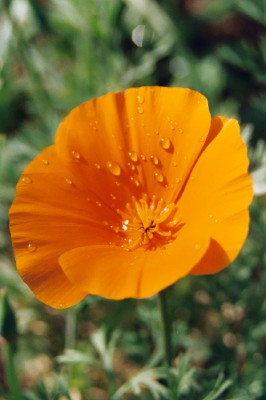
It was the sight of those exquisite flowers which first caught my attention. I've never seen flowers weeping before. Now those of you with a delicate disposition had better look away, as I'm about to show you quite the most eye-popping and frankly embarrassing seed capsules I've ever seen.
In case you wanted a closer gawp at those...
You can look again now. Here's a more calming photo of the leaves.
It was about 5ft high or so, and multi-stemmed - a sort of loose clump, I suppose. I am deeply smitten, so if anyone out there knows what it is and can introduce me, I will be eternally grateful.
Monday, November 02, 2009
Torquay treasures
That's Fawlty Towers, kiss-me-quick hats, blokes with knotted handkerchiefs on their heads and deckchairs, right?
Wrong.
It's the proud home of quite the best municipal planting I've ever seen. VP - you should get down there and take some pics for that OOTS strand of yours asap.
We've just come back from a little break there: I won't bore you too much with what we got up to, though we did find a hotel John Cleese would have been proud of to stay in.
Instead I shall just introduce you to the Palm House at Torre Abbey. The head gardener - employed, take note, by the Torbay Council's Parks Department - is career changer Ali Marshall, who used to be something in business administration but for the last year (only a year?!) has taken the helm at Torre Abbey. And my goodness, is she an inspired plantswoman.
It's a small garden, but there's a lot packed in. A dahlia border so densely-planted I mistook it for a rose garden from a distance; a cactus house with three-foot-across hummocks; palms a go-go and a bank of cannas. There was even a recently-planted Agatha Christie garden which owed a great deal to the Poison Garden at Alnwick but with a sleuthing twist.
But it was the recently-restored (as is everything at Torre Abbey, thanks to the Heritage Lottery Fund, gawd bless 'em) 1960s Palm House which stole the show for me. There weren't many labels so I gave up trying to identify everything in the end and just marvelled.
You wouldn't believe it's a public garden run by the Parks Department, would you? Talk about showing everyone else how it's done...
Saturday, October 31, 2009
Roses in November
There is no last rose of summer any more. There might be a last rose of late winter at some point, I suppose, but this is, these days, a late summer or autumn flower. If not a winter one.
Certainly here it is, November tomorrow, and my garden is full of roses.
An unidentified miniature patio rose growing in the kids' garden.
Rosa 'Perpetually Yours'
A budding Rosa 'Dublin Bay'
Lots of buds on my container-grown Rosa 'Wildeve'
I just can't make my mind up if I like it.
Thursday, October 29, 2009
Netting niggles
Is it my imagination, or are the leaves coming down faster this autumn?We've had a week or so of brilliant colour, and now it's like a wall of yellow confetti. I can't help feeling a little cheated: autumn is my second-favourite season (after spring, of course, silly) - something to do with the sudden onslaught of colour on senses bleached by the white light of summer.
But onto more prosaic subjects: each autumn I get into trouble. This is because I net my pond, a job I carried out about a week or so ago using a roll of reasonably small-gauge plastic netting I use every year. I weight this down with bricks to keep it taut and work the occasional length of wood underneath to keep it clear of the water.
Trouble is, my uber-wildlife-friendly friend tells me this is absolutely not what you should do if you want to be nice to nature. As of course I do: this is after all meant to be a wildlife pond. She says I'm trapping all the lickle creatures in the water so they can't get out. She gets a bit more fuzzy about what exactly happens then: after all, I said to her, I surely would have found rafts of drowned newts floating on the surface in spring if it really was a problem.
I say they can find their way out through the gaps (alongside, for example, the bricks) if they need to, and besides, it would do the wildlife a whole lot more harm if I let all the leaves fall in and rot into a stinking and stagnant mess on the bottom.
So who's right? Since we've reached something of an impasse I thought I'd hand it over to those who know more about these things than I do. Has anyone out there got any light they'd like to shed on the matter? Any intensive research studies on the winter habits of pondlife and the effect thereof of plastic netting I should know about?
All authoritative conclusions gratefully received...
Tuesday, October 27, 2009
The path to enlightenment #2
Step 5: start mixing your mortar. I went for a 1:4 mix of cement to sand which seemed to work pretty well. You slosh a bit of water in and then squirt some washing up liquid after it - this keeps the mortar elastic - before using the oldest spade you have to mix it up until it's the sloppy side of solid - about the texture of blancmange. This is the best way of ruining gardening tools I know.
Step 6: Use the mortar to set your edging bricks. At this point I thought I'd better start taking some pictures of my somewhat erratic progress.
This bit isn't quite as bad as it seems: I used pegs and string to mark the outer edge of the path so I had a line to follow and then it was a matter of using a rubber mallet to knock the bricks in place.
Step 7: go and do something else for a day while it all dries.
Step 8: it's time to play with the sand you ordered, if the neighbour's kids haven't got there first. A 2" layer inside the brick edging, if you please.
Step 9: level the sand and dry-lay the bricks, making sure they're level in every direction - I put a gentle camber on mine from one side to the other to drain the water off.
At this point Joe Swift produced a natty little bit of wood, with the profile of a brick cut out of each side so it "hung" on the sides of the path and acted as a template to smoothe your sand level.
I thought this looked like a good idea, so gave it a go. Sadly, I quickly realised the catch: it does assume that all your bricks are identical. In some misguided attempt to be a bit more environmentally sound we'd bought our bricks reclaimed at an auction, so they were every possible size, shape and thickness you can imagine and I had to lay them all individually, using my little rubber mallet and taking Bloomin' Ages.

Still, it's starting to take shape and look ever so slightly like a proper path by now.
Step 10: Mix some more 1:4 mortar but don't put the water in this time. Make sure it's not raining, or even a bit damp, and use one of those little pointing trowels to feed the dry mix into the gaps. Then follow up with a stiff brush so there's not even a little bit left on the surface of the bricks (where it will set in a grey and depressing mat of concrete). This is why it's essential your bricks should be dry before you start this bit.
By the way, the grey and depressing bits on the bricks above were already there - see reclaimed bricks comment earlier.
Now, I was lucky and it rained the night after I did this so all the mortar was beautifully watered in and set almost straight away. But if it doesn't rain, you'll have to do this yourself with a hose set on sprinkler - don't blast water at it all or you'll wash out all the mortar and have to start again.
By the way, being a very amateur bricky, I cheated.

I have three holes in my path: here, where the four arms of the cross meet (there are two little side-paths off to my shed and my greenhouse - oh, no, I'm not over-ambitious, oooooh no) and at each end, where the squares I made under the gates in and out were, ahem, not exactly square.
One of the many things I discovered through making this path is the reason why brick paths are always an odd number of bricks across. The width of my path, for reasons lost in the mists of history, is six bricks across for the main bit and four across for the side paths. This doesn't work, and my maths isn't up to working out why. So I just fudged it. A little concrete and a few pretty pebbles should fill in the hole nicely.
Doncha just love amateur DIY enthusiasts? What can I say - I make mistakes so you don't have to. Still, I got a pretty good new brick path, and I learned an awful lot of things - chief among which was that It's Never as Easy as it Looks On TV.