Friday, October 12, 2007

Season of mists...

There's a definite autumn tinge to the air now. It's been misty the last couple of days and the leaves are just turning that russety shade of brown that means any minute now we'll be out with the leaf rakes and collecting what seems like tons of the things.

Which is why I've been sorting out the leafmould bins for one of my clients. She has a fabulous big woodland garden, full of lovely mature natives like beech, oak and whitebeams (one of the loveliest trees if you have a chalky soil - it has silver undersides to its leaves). Unfortunately, though she has two massive leafmould bays, they were full of roots and half falling down, so they took a lot of work to get functioning again!


I'm there now though, after a couple of sessions of digging out a mixture of nettle and tree roots and sorting out the rotted stuff - some many years old - from the new leaves which had been dumped on top. Now I have two bays, about 10ft x 10ft (I told you it was a big garden) made of posts driven into the ground with green wire chainlink fencing round it. You need plenty of air in a leafmould bin to make good mould, so things like compost bins, with more solid sides, don't work: chainlink fences are ideal and last for years, though you have to have strong uprights which are well driven into the ground as the weight of the leaves can be enormous.


Now I have lots of lovely old leafmould to spread as a mulch on her borders. It makes a great autumn mulch as it's low in nutrients so won't spur plants on to put out unseasonally tender growth, and it still adds plenty of organic matter to the soil (desperately needed on her thin chalk). One of the many good reasons to have a garden in the woods!

Tuesday, September 25, 2007

Horrible diseases

Here's something to strike fear into your heart: first box blight laid waste to our clipped hedge topiaries, then it was sudden oak death threatening the most English tree of them all. Now that stalwart of the English garden, the fuchsia, is under threat from a new bug, the fuchsia gall Mite.

It's been spotted in Hampshire and causes twisted, distorted growth at the end of fuchsia shoots and branches. Let's hope it doesn't get much further - fuchsias may not be my favourite plant, but they're good-looking, dead easy to look after, I grow lots of them in various gardens and we'd all be poorer without them.

Tuesday, September 18, 2007

Plant of the month - September

Leycesteria formosa

Pheasant berry


This has to be the best value shrub in my garden. Just now the purple berries are starting to darken to almost black, bringing this year-rounder to its peak. The year starts with brilliant green leaves emerging: later in the summer they develop a purplish tinge. The flowers start appearing early - about June - in fountains of raspberry ice bracts held demurely under the leaves, each one harbouring a tiny, relatively insignificant white flower. The flowers, though, develop into these fabulous, luscious berries which last well into autumn - unless, of course, you have pheasants in the area, in which case you'll be besieged. The interest lasts through winter, too, as the vibrant green stems stand right through till spring. All this for the price of a little pruning in spring (remove about a third of the oldest branches to keep the youngest, brightest stems) - this is truly a plant which has it all.

Monday, September 17, 2007

Cloud-pruning hedges

One of my clients has an accidentally cloud-pruned hedge. This arcane art from Japan is all the rage at the moment, but when I informed her she was cutting edge (literally and metaphorically), she'd never heard of it. The hedge, she told me, had just grown like that: she and her husband had been pruning it with shears since they moved in about 50 years ago and they just followed the contours of the hedge without bothering too much about straight lines and sharp edges.

It's a lovely thing: all curves and sensual, billowing waves. It takes me eight hours to prune it with hand shears each year, which is a real labour of love, but it's worth it. You can see bits of it swelling and retreating as the years go by: holes appear and disappear, and bulges are smoothed out and then turn up somewhere else. I've never been so aware that a hedge is made up of living, breathing plants: beats a boring old box square any day.

Friday, September 14, 2007

Back again!

No prizes for guessing where I've been!

What precious seconds I've had to spare this summer in between juggling small children on school holiday and the normal demands of work have been spent out in the garden dodging the raindrops, so my computer has remained lonely and neglected in the corner. Now though with autumn in the air and everything beginning to wind down, and - most importantly perhaps? - the kids back at school, it's time to catch up with what's been going on!

Verdict on this summer - a washout, and I think everyone agrees. It hasn't been much fun for anyone on the beach, but I think it's been fantastic for the garden despite misery-guts moaning about floppy perennials from telly gardeners. That just hasn't been my experience at all: the roses have been flowering fit to bust, having for once in their lives had enough water all summer in my thin sandy soil; my Amelanchier - which I shouldn't really be growing since it's from the American wetlands - has put on a foot of growth; and I haven't had to pick up the hosepipe once. After the horrors of last year's drought, I've been revelling in this summer: the light may have made it hard to catch the flowers at their shining best, but they really have been at the best I've ever seen them. And a few wet pairs of gardening gloves is a small price to pay for that.

Wednesday, June 27, 2007

Hedging your bets

The year rolls on... now it's time to dust off the hedgetrimmers and get to work. A week or so ago it was a client's privet hedge, now it's the beech hedge round our front garden and the wildlife hedge at the back.

I'm more than a bit proud of our beech hedge. We planted it ourselves, about 4 years ago after we'd grubbed up a horrid leylandii hedge. Being me, I didn't do things by halves: I dug a big trench, poured barrowloads of manure in to improve the soil, then planted my staggered rows of beech saplings 18" apart and back-filled. Then I watered them in very, very well and mulched deeply with well-rotted stable manure.

So far, so what most people do. But ever since, I've taken care of the hedge in just the same way as my perennials: I think perhaps this is where people go wrong, in that they forget that hedges are groups of plants, not just inanimate walls, and have the same needs. So I watered the hedge in the droughts, mulched it every spring, and kept it free of weeds.

Result: a four-year-old hedge which looks like it's been there 10 years. Beech hedges are notoriously slow to establish, and the books say you shouldn't expect a dense hedge until at least 5 years. Ours took three: and I'm convinced it's because I took good care of the plants, and am continuing to do so. We're reaping the rewards now: all that hard work has really paid off, and my little beech trees are thanking me in the only way they know how!

Monday, June 25, 2007

Camellia problems

I was up in the 3/4 acre woodland garden I look after the other day, and cutting back a camellia which was overhanging the pathway quite badly (this is the kind of thing I spend most of my time doing in this particular garden - the amount of green waste I remove from there has to be seen to be believed!)

I noticed pretty quickly that behind the curtain of fresh green leaves there was a problem. All the older leaves were covered in a sticky, black sooty mould, which not only looked nasty but also couldn't have been doing the shrub much good.

I wasn't quite sure myself what was causing it - I thought aphids of some sort, since this is what causes it on roses (the aphids secrete honeydew, which drips on the leaves below and is consequently colonised by the fungal sooty mould). I was a bit unsure about this since I've never heard of aphids attacking camellias to any great degree.

Anyway - I came back and looked it up, and thanks to the dear old RHS I discovered we almost certainly have not aphids, but Camellia cushion scale.

I have to go back and check whether there are yellow-brown scale insects near the veins (or indeed "white waxy egg masses"). But everything else fits.

The good news is, this is just the right time of year to control it. I'm going to have to spray; I'll try the organic version first (Growing Success Bug Killer or Vitax Organic 2in1) and if that doesn't work, I'll zap it with the very un-environmentally friendly Provado. My client tells me he has a backpack sprayer in his garage (the shrub is about 15ft tall) - so time to tog up and do battle!

Wednesday, June 20, 2007

Choice choisya

Another good shrub for cutting back at this time of year is Choisya ternata "Sundance". About now those lovely sunny yellow leaves which lifted your spirits through the worst of the winter weather turn a pale washed-out shade of sickly. It's time to prune them off and allow the new, green growth to come through and turn yellow in its place. It also gives the bush a lovely rounded shape for next winter, as the new growth comes through in nice neat rosettes and all stays the same length, more or less.

It's pretty simple - just take the secateurs and trim down to the next rosette of leaves, usually about 6" or so down the stem. If there isn't a rosette, just trim out the whole stem. You don't need to cut it back hard: just shape it to the size you'd like and leave it.

Choisya is one of the few shrubs you can hack back without ruining the appearance: though it does change colour temporarily, from yellow to green, a healthy plant carries enough leaves in the centre of the bush to keep it looking nice and dense. After you've finished, give it a feed of pelleted chicken manure and a good water and mulch, and it'll be set fair to keep you smiling in winter all over again.

Tuesday, June 19, 2007

The things you see out gardening...

I was happily laying into an overgrown cotoneaster in the big country garden I look after this morning when I heard a low humming noise.

I thought at first it was a bug flying around my ears so I was swatting away when the hum got louder. And louder. Finally it occurred to me to look up, and there was the biggest swarm of bees I've ever seen. Actually, the only swarm of bees I've ever seen.

They came up the hill from the open fields behind, a great big black cloud of them, making that insistent, purposeful drone as they came. I watched in awe as they flew overhead and made for the far side of the garden (thank goodness - I had momentary panics over what I'd do if they decided I looked interesting). I looked for them later but couldn't see them - not sure what I'd have done if I had, to be honest.

It all prompted me to look into this funny business of swarming. Funnily enough, the first place I found was a local council not far from me, at Elmbridge. Here's what they had to say:

"Colonies totalling as many as 20,000 bees can and will swarm. The noise of a bee swarm can be alarming but the danger is not very great. The swarming bees will cluster, possibly on a tree branch, and should be collected by an experienced beekeeper (contact your local Environmental Health Department or the police if a beekeeper is not known to you). Honeybees can sting, especially if you venture close to their hive. "

Apparently honeybees swarm, but bumblebees don't. And I discovered a whole website dedicated to informing people about honeybee swarms, at Swarms.net: here's what they say:

"Honey bees swarm to multiply the number of colonies and thus propagate and perpetuate the species. By division of the bee stocks in the hive, those left behind have honey stores, and along with young bees about to hatch is a young queen in her special cell.

The bees that swarm with the old queen do not go far from the hive. Maybe because queen bees do not fly as well or as fast as workers! They will move on from each resting spot until a new home is found. (Or until a beekeeper collects them and puts them into a new hive.)

Swarms can survive for a number of days on the honey stores they filled themselves with before leaving the hive. As the days pass they will be more upset when approached - hence its important to get a beekeeper to collect them quickly. "

You learn new things every day... hope whoever finds their swarm when it finally settles gets some nice honey out of it!

Monday, June 18, 2007

Hacking at lilacs

This is a great time of year for cutting back overgrown shrubs, especially spring-flowering ones. Lilac is a prime target, as well as evergreen ceanothus, berberis, pyracantha... pretty much anything that doesn't flower later this year, really.

I spent a couple of hours laying into a client's lilac last week. It must have been 20 years old, and about that long since it was last looked at: it was heavily congested in the centre and the 4" thick branches were splaying outward and endangering his shed. And it was about 25-30ft tall, which would have been fine in a big garden but his is a small-ish suburban strip.

I like to think of this kind of pruning as rejuvenating pruning - though it also counts as common-or-garden hacking back. What you do is remove about a third to a half of the wood - taking out the thickest, oldest branches first, and then any which are pointing in the wrong direction, as well as any which are diseased and/or dead, of course. If you're me, you find it hard to know when to stop, especially with lilacs: when they're overgrown, they tend to develop long, leggy stems with the leaves and flowers right at the very end, and that means once you've taken out the bulk of the shrub, you're left with some rather sad-looking whippy lengths of wood waving around in the breeze. It all looks very odd.

Fear not: this is quite normal. The thing to do is to leave it looking a bit wierd this year, and wait until the stump starts pushing up new growth, which it will do very quickly. Then next year you can cut out another third of the long whippy old wood; and by the third year, when the new growth has got to a decent height and will be flowering well, you can take out the last third to be left with a bush that's all the same height, hopefully a nice shape and full of strapping young growth which looks far nicer and is much more healthy.

Friday, June 15, 2007

The Wisley glasshouse

One of the great privileges I have with my garden writers' hat on is that I get to go to sneak previews - and last night I went along to the unveiling of the new glasshouse at RHS Wisley, which opens to the public for the first time today.

Since I'm such a regular visitor to Wisley, I've been watching this amazing structure going up gradually over the years, and went along to another press bash in February to see it as the planting went in - well, then it was almost entirely under water after a winter of torrential rain, and we were all taking bets on whether it would be ready in time to open.

We needn't have worried. It's quite amazing what they've done in the four months since then: it still looks very "new", and the planting outside (designed by Tom Stuart-Smith) is just in so will take some to show what it's made of: but inside it is breathtaking. It's going to be wonderful watching it grow over the months and years to come.


Here it is: a little stark, perhaps, until the exterior landscaping develops, but a remarkable structure nonetheless. It was designed in Holland, and doubles-up as a water collection system.


At the centre is a magnificent waterfall - you walk behind it as you pass from the temperate side into the tropical. The rock is artificial, and hides a "root zone" exhibit underneath.


There were orchids in the palm trees: I wasn't quite sure if they were there for our benefit, or if they're going to stay! They looked fantastic, anyway.


And then there were the plants... these Philodendron leaves were up to two feet long and that soft, velvety texture was so utterly gorgeous. And this is just a baby plant...


Outside in Cleve West's teaching garden, there were loads of great ideas - I'm going to nick this fantastic birch-log path for the jungle area around my pond.

Thursday, June 14, 2007

Flopping around

Another little job that always gets the better of me every year is the staking.

In my defence, I will say I keep trying to grow new things and then discovering too late that they are the kind of things that flop in an ungainly way over everything around them once they get to flowering. Last year it was Aster "Climax" (now moved to the cutting garden); this year it's a big clump of Anthemis tinctoria "Kelwayii", a brassy yellow daisy with profuse, pretty flowers which I grew from seed last year. I planted three as young plants, but they didn't do much last year, despite being touted as first-year-flowering perennials - I suspect though it might have been to do with my thin soil rather than anything else. Anyway, this year they've shot up, to about 4ft tall, and as soon as they formed flower buds they promptly crashed to the ground.

Sadly for the hemerocallis behind, to say nothing of the poppies all around and a hellebore or two, floppy plants mean crushed neighbours and a bare centre where the clump has fallen outwards. It's extremely unsightly and very bad for the border.

As usual, I've done a sticking-plaster job - really tricky this time as unlike the Aster, the Anthemis is near the front of the border. Actually I'm quite pleased with how it's gone: I had some old plant supports someone gave me, real instruments of bondage with five vicious-looking wire "arms" which until now had flummoxed me as to how to use them. Fortunately they sink nicely into the ground and the arms hold up the Anthemis nicely. Situation saved: but, like the Aster, the Anthemis are now earmarked for an alternative home next year!

Wednesday, June 13, 2007

Back to the wall

I've been giving my ceanothus a haircut this week, as it's trained against a fence and needs an annual prune to keep it tidy.

Wall-training shrubs which are otherwise inclined to get a bit big and unwieldy is a great way to keep them in bounds. Ceanothus is a good candidate, and so is Japanese quince (Chaenomeles japonica), pyracantha and Garrya elliptica. The small-leaved cotoneaster, C. horizontalis, holds itself so rigid it practically stands up against a wall by itself, without supports.

The principle is pretty straightforward: you'll need supports, such as wires spaced about a foot to 18" apart, to train the shrub onto before you start.

Then, year by year, you shape the shrub so it's flat against the wall. You do this just after flowering: just prune out any branches growing out away from the wall completely or, if you're at risk of ending up with bare stems, you can prune back to one or two leaf joints from the stem.

Tie in side shoots pointing the way you want them to go, and then trim any upward-growing stems to about an inch (2.5cm) below the top of the fence or wall. If any longer side shoots are growing beyond the bounds you want them to keep to, shorten them, too.

Pyracantha in particular makes a really lovely espalier if you do this: ceanothus is a bit more bushy, so you get a pleasing evergreen "coat" to disguise your fence with. In any case, you avoid the problem you get with climbers where they're forever climbing next door, or over the neighbouring shrubs; and it looks great, too.

Monday, June 11, 2007

Home-made perfume

One of the sidelines of my cutting garden is left over from its previous incarnation as a herb garden: I've got a row of plants specifically dedicated to producing perfume.

At the moment - since the whole thing got interrupted so wasn't completed properly - it consists only of English lavender and Apothecary's Rose (Rosa gallica officinalis). The rose is currently flowering its head off and so I'm gathering the petals and drying them on a shelf in the shady corridor that runs from one back door to the other, between my office and the kitchen. It might sound like an odd place for drying flowers, but in fact it fulfils all the main requirements in that it's shady, cool and there's a draught running through it regularly.

At the moment I'm not quite sure what I shall do with the dried petals: I could make simple rose-petal pot pourri, which just means dried rose petals in a bowl. That would be nice, but I'm not sure how long it will last. What I'd really like to do is to make wet pot pourri - the type for which it is named (it literally means "rotten pot"!). This involves packing layers of petals which have been dried for just two days in a big crock with rock salt. Unfortunately since the pot needs to be clay or similar (i.e. not see-through) I've got a problem sourcing one - large glass jars are relatively easy to find, but big clay crocks went out with my grandma. The search begins!

Friday, June 08, 2007

Plant of the month - June

Rosa "Dublin Bay"


I first spotted this lovely climbing rose in the rose gardens at RHS Wisley, where I was looking for a true, pure red. So often in roses you find reds that aren't red at all - they're orangey-red, or pinky-red, or scarlet (i.e. dark red). "Dublin Bay" comes as close as it's possible to get to a clear, pure, red red. The only downside I can detect is that it doesn't have any appreciable perfume. It's a robust, healthy plant that grows lustily but remains well-behaved: a rare combination that makes this rose all the more covetable. Its strong stems are a dusky shade of purple when young, adding to the charm of what must be one of the best climbing roses available anywhere.

Thursday, June 07, 2007

Chelsea chic

As I mentioned a few days back, I had the fantastic experience of spending a whole week at the RHS Chelsea Flower Show just recently. And what a show it was. I had been a bit worried that I'd be all jaded this year - I did the same thing last year and was all wide-eyed and star-struck by it all, so I thought this year I'd be all "been there, done that". I needn't have been concerned. It was just as exciting to be there, the atmosphere was just as electric, and all those mouthwatering, beautiful plants...

The thing Chelsea did to me last year and has done again is to give me a sense of my own insignificance. I tend to strut around here at home thinking, I'm a professional gardener, I know it all - but when you go to Chelsea, you realise what an amateur you are in comparison to these utterly dedicated plantaholics. They're so talented, too: the perfection it takes to get a gold medal at Chelsea has to be seen to be believed. When you've watched someone spend a whole hour teasing dead strands from a Stipa tenuissima, you know you're in the presence of the highest standards it's possible to imagine.

So, suitably humbled, I thought I'd just share my favourite Chelsea gardens from this year's show. There were some real crackers: nothing head-and-shoulders above the rest, like Tom Stuart-Smith's garden last year, but several which really grew on you (like Jinny Blom's Laurent-Perrier Garden, and Ulf Nordfjell's Tribute to Linnaeus). And, just for the record - I entirely agreed with the RHS judges in giving the Best in Show award to Sarah Eberle's 600 Years with Bradstone. It was the only truly original garden there, executed with panache and daring, to say nothing of excellence: and every time you looked at it, you saw something else. You can't ask more of a Chelsea garden than that.


This was Kate Frey's garden for Fetzer Vineyards. Have you ever seen such wonderful flowers? The gorgeous blue ones were Phacelia campanularia - a new one to me, but a native wildflower in California. Kate - a lovely, gentle person who you can tell was just born to be a gardener - is a master at recreating wild landscapes like this: you can't really believe such beauty is possible on such a small scale.


This was Jinny Blom's garden for Laurent-Perrier. Jinny was over the moon about her gold medal - it's the first time she's struck gold after several years of trying. You could see why, too: the planting in this garden was ultra-sophisticated and very, very subtle, and she'd obviously put a huge amount of thought into it. And that moongate sculpture was something else: it moved around the garden with you. Fabulous.


This was another super-sophisticated garden with some really accomplished planting - I thought it had a good shot at Best in Show had the judges been playing safe. Robert Myers reflected the old, traditional nature of the Fortnum & Mason department store which sponsored the garden - but at no point did his charming garden feel stuffy. The garden was full of subtle little touches of brilliance: behind those beehives (which provided a major talking-point at the show) that fencing is made of old Fortnum & Mason hamper lids. And the clock at the back was set to seven minutes past five - or 1707 in 24-hour clock, the year Fortnum & Mason was founded.


Tiggy Salt's small courtyard garden, Where the Wild Things Are, was a big hit, with adults and children alike. This is pure Chelsea theatre: the night sky formed a background to a recreation of Maurice Sendak's classic children's book, and a wonderful copper boat was there to take Max from his chamomile bed across to the "forest" of Fatsia japonica. It was magical.


And an odd little snippet: this Italian Scarce Swallowtail butterfly hatched out halfway through the show, having been imported as a chrysalis on a yew at the Romantic Gardens topiary display in the Great Pavilion. It fluttered over to the Claire Austin Hardy Plants display next door - presumably the irises looked prettier - before finally flying off. Apparently only a handful have ever been seen in the UK before. Look out for this one in SW3 for a few weeks to come!

Wednesday, June 06, 2007

Plant of the month - May

Iris "Lothario"


It took a long time to get there, but boy was it worth the wait. I planted this lovely bearded Iris way back in autumn 2004, having bought it from the wonderful iris specialists, Claire Austin Hardy Plants. It had a bad couple of years - too overshadowed by nearby plants in 2005, then took last year to recover - but this year it's come into its own and is producing bloom after fabulous bloom. Palest mauve petals shade down to a lovely dusky purple fall, with that palest yellow beard setting the whole thing off. It's like having a wildly rococo can-can dancer in the garden - and she's stealing the show.

Tuesday, June 05, 2007

Dear diary...

I've been trying to find a way of keeping track of the plants and jobs in my garden. Until now I've just used a good old notebook and pen, but of course it's difficult to include photos and there's lots of bits and bobs you can't do - like cross-reference plant details or this-time-last-year entries easily.

Since this is an obvious application for a computer programme, I've been having a look at what's on offer. Surprisingly, there's very little by way of interactive gardening calendars: surely someone out there can spot this gap in the market?

Shoot is probably the most recent application on offer - it's actually a way of selling your house by advertising its wonderful garden, which is a great idea in itself. But it also works as a big club for garden owners and allows you to pick out your plants from its massive database and add them to your virtual garden. Even better, they'll then email you regularly with advice on how to care for it all. The downside: you have to pay for it. The paltry eight plants you're allowed to download for free doesn't go very far - cannily, they've made sure it's just enough to get you curious for more so you'll fork out the £20 or so it costs for a year's membership. But if you're willing to pay, it's a great service and well-run enough to be head and shoulders above the rest.

For free, the BBC Gardening website does a calendar too. For some reason it's well hidden on the site and takes a bit of finding - perhaps they're still developing it. It could do with a few extras: the plant list is very limited, and there's no email reminder (and the tips they give you are kind of basic). But they do allow you to keep an online note-style diary for the garden which you can refer back to easily.

And... er... that's it! Apart from a handful of CD-roms which do the same sort of thing but I'm sure have the same sort of drawbacks. I think I might just have to invent my own... unless someone beats me to it!

Monday, June 04, 2007

Back from Chelsea

I've just spent a couple of weeks away from the garden - at the Chelsea Flower Show (fantastic!) where I have had the privilege of a press pass for the last couple of years now, and then on my hols in the Isle of Wight.

More of Chelsea later if I get a moment... but what is it about going away even for a short amount of time that makes your garden suddenly decide it's going to romp away and grow for England? Since I last looked at it, the Goliath poppies have burst into action, to say nothing of several self-seeded orientals - some are a beautiful clear orange, the first time that particular colour has turned up, and really unusual. My roses are blooming fit to bust (Dublin Bay - a scarlet climber - is particularly lovely), and several smaller shrubs have simply disappeared under the mass of vegetation that's suddenly burgeoning from every corner.

Not that I'm complaining: June in my garden is fabulous, and the peak of the whole show. It's so lovely to look out of your window and just stare, transfixed by something that's in your own back garden. What a privilege.

Saturday, May 19, 2007

Main border: May 07


Here's my main herbaceous border (the Christopher Lloyd Tribute Border as I now call it - though it's a long way from finished, and as you can see doesn't bear a lot of resemblance to Great Dixter just yet!). It's Californian poppy season, so I've got them in rivers through the other plants - lovely. You can just make out the last of the forget-me-nots (which have slightly taken over this spring) and in the foreground the Phacelia tanacetifolia is making a lovely pale mauve contrast. The cardoon (Cynara cardunculus) is revving up nicely and should be spectacular soon - already the foliage is looking great. The purple dots are alliums, which are dotting the border nicely - I've got Purple Sensation and A. christophii already out, and A. giganteum about to burst into fireworks at the back. You can just about make out the irises, too, at the top left-hand corner: I've got some fairly plain but nice irises, probably sibirica, but the star of the show has been I. Lothario, which you can just about make out in the picture. It's been spectacular this year, and is the first year it's really flowered, though I've had it about three years now - I think I've finally managed to keep it clear of competition from other plants. It's all looking lovely - slightly blowsy but full of interesting things to look at.

Thursday, May 17, 2007

Flowers for cutting

I thought I'd say a bit about my cutting garden, as it's this year's project and very much at the front of my mind just now.

I've carved out a more-or-less square plot, about 19ft x 19ft, on the far side of my greenhouse where it's pretty sunny most of the day. It's overshadowed by a large goat willow, but not too badly, and I'm in the process of raising the willow's crown so it doesn't cast too much shadow.

The design is quite simple: a 2ft bed around three sides of the square (the fourth is for my greenhouse and coldframe), with two 4'6" wide beds across the middle. It'll all be enclosed in 1" x 4" pressure-treated timber to define the beds and make maintenance easier. There are also 30" paths around the beds for access.

The area was previously a herb garden (a bit ott since I had it in mind once upon a time to set up a herb nursery - then realised how much work was involved). Result is I need to dig out large amounts of lemon balm, chives and lovage before I can plant. The good news there, though, is that the soil is in good heart as it's already been dug over and improved once.

So far I've got lavender and Rosa gallica officinalis, also known as Apothecary's Rose, along one long side, for drying as pot pourri; the short side will be for perennials for cutting - so far a clump of asters dug up from the main herbaceous border, but I'll be adding bulbs (daffs and tulips), a statice (great for drying) and whatever else I can find. I've added a Chimonanthes praecox (wintersweet) in the corner - again rescued from imminent suffocation in the big herbaceous border - thinking I'll cut branches if ever it gets around to flowering (they're notoriously slow to settle). Along the front edge will be dahlias, chrysanths and any other late-season perennials I can think of.

In the centre beds, so far there are only sweetpeas climbing up rustic hazel poles: but my antirrhinums are chomping at the bit in the coldframe waiting to be planted out, and I've got plenty more coming on to join them there. It just needs me to keep up with them by digging out a home, and we'll be raring to go!

Tuesday, May 15, 2007

More weeds than plants

This time of year it always happens, just the same. I look out at my garden and suddenly realise that without my even noticing it, there are more weeds than plants.

How does it happen? One moment it's all tulips and forget-me-nots (and boy was the display gorgeous this year), the next I realise I haven't thinned the honesty seedlings which are now monsters staging a border takeover, and there's a whopping thistle poking its head up and vying with the alliums for top billing.

Nothing for it - out into the beds wielding a fork and laying waste to all that greenery I had so innocently thought was plantery I wanted. Next spring I'll keep up with the weeding from the moment those little thugs start off, instead of being distracted by all those sweet little seedlings poking their heads out of the potting compost in the greenhouse and demanding water, potting on, hardening off, planting out... well, maybe...

Monday, May 14, 2007

Sun today, rain tomorrow

The weather really can't make up its mind. We've just had the driest spring on record: six weeks without a single drop of rain. And that's in 20-degree temperatures - by English standards, that's summer. My poor garden was getting more dessicated than a Dr Who victim (sorry, my 7-year-old is obsessed and I therefore have an hour's Dr Who indoctrination every Saturday evening. It has a way of seeping into everything else, too.)

Now, we've had nothing but rain for more than a week. Admittedly, that's far more typical of your average English spring, but we do usually have the odd dry-but-cloudy spell to ring the changes. Now the path down the garden is once again under three inches of water and I can't get out there as it's a quagmire and there's no point planting anything until it dries out a bit.

My greenhouse is very well-tended, anyway - the only dry spot in the place. I put my cucumbers into the earth border today (this post should probably go in my allotment blog but what the hell). They're "Cum Laude F1" - the seed cost a bomb but lovely little plants. The rest of the greenhouse is bursting at the seams - I'm sowing seed every two weeks all this year to keep allotment, cutting garden and Christopher Lloyd summer bedding scheme in full production, and my humble little 6ft by 8ft can hardly stand the pace.

Friday, April 27, 2007

Trimming to size

Back to the monster mahonia again yesterday - I came to the conclusion that I'd see what happened after I'd done some restorative pruning (i.e. thinning out the very congested centre, removing crossing branches and so on).

Luckily that did take the height down a bit and what with a few judicious cuts which removed the remainder of the really tall bits, I managed to take about 5ft off the top without actually changing the shape of the tree much. I also had a lot of fun climbing about in the canopy - it doesn't take much to get me up clambering about in trees!

Result is a happy client - he got his view back - and happy me, having preserved a very special plant. I've revised my opinion of mahonias and will be recommending them as an unusual architectural plant to designers - but as 20ft trees, not the modest little specimens you see in most gardens.

One other thing - I have for my sins agreed to take over running the garden at my local primary school. Why is it we gardeners are such suckers for co-opting more things to grow and spaces to grow them in? Hopefully I can delegate a lot of the work to other parents - but I have to confess, I'm secretly quite excited about this little pond area they have there, which I plan to make into a fantastic little wildlife garden. Minibeast heaven. More later...

Wednesday, April 25, 2007

Mystery tree

I found a tree at the bottom of the garden I had no idea I had the other day.

This is all part of my little project to clear the overgrown mess around my garden pond and make it into an intentionally overgrown jungle area, so I've been removing a big old forsythia and a massive clump of Kerria japonica (both great shrubs but only if you like that particular shade of brassy yellow... I don't).

Having done that I realised there was a multi-stemmed something-or-other there and since I don't get rid of things I can't identify I've been watching it with interest as it leafed up and formed flower buds.

Well now it's flowering - and looks just like a honeysuckle. Except that it's about 20ft high... and the flowers are about half the size of a climbing honeysuckle - here's a pic:

Pretty, isn't it? I've been emailing the Cambridge University Botanic Gardens, which has a national collection of honeysuckle (Lonicera), and good old Wisley, both of whom have asked me to send them a sample. So I'll chop off a bit today and post it. I think either way, it's such a pretty thing it's staying (even though it's not very jungly) - how lovely, just like getting a present!

Friday, April 20, 2007

Monster mahonia

You know those modest unassuming mahonias you find tucked away in a corner in most gardens, doing their stuff in about February with puffs of yellow pompom flowers and then retreating into the background for the rest of the year?

Well - I met one that was 25 feet tall yesterday. It was in the garden of a client of mine and he was asking me to prune it back, since it hadn't been touched in the 20 years or so since it was planted. It's such a magnificent plant: craggy bark like a crocodile's skin, bright yellow wood and these wonderful, architectural leaves. This time of the year it's hung with strings of bluish-green beads which eventually will develop into black seeds (apparently they can be eaten and are known as Oregon grapes in the US).

Normally you only ever see these as shrubs a few feet high if you're lucky. But what nobody tells you is that they can serve as small multi-stemmed trees if they're happy enough. They can be stooled and grown from the base if they get leggy, but though this one is, it's also very deeply architectural and quite amazing to look at, so I'm very hesitant about butchering it. With special plants like these, taking your secateurs (or pruning saw, in this case) to them is a doubly scary thing to do. I shall ponder for another week before I have to finally make a decision next Thursday.

Wednesday, April 18, 2007

Cornwall #1 - The Lost Gardens of Heligan

I'm just back from a little break in Cornwall, where gardening is a religion. The result is some of the most beautiful gardens in Britain, and I had a fantastic week sampling some of the best.


Top of the list for me was the Lost Gardens of Heligan, a valley a little way inland from the coast at the fishing town of Mevagissey, "discovered" by entrepreneur Tim Smit who put his considerable talents into making it happen and then ensuring everyone knew about it. The best thing about him is that it's not just hot air - the projects he gets involved with are genuinely worthwhile and something to get really excited about.


The Lost Gardens are no exception. This is a truly magical place that has such atmosphere: you can do the technical gardening thing in the extraordinary, and beautiful, walled vegetable garden, or wander gently through the northern gardens or along the valley bottom and lose yourself watching tadpoles wriggling in the shallows of the necklace of pools that runs along it. Or you can marvel - and I really mean marvel - at the jewel in the crown, the fabulous jungle ravine where tree ferns jostle each other among Californian redwoods and unbelievably massive rhododendrons. If you haven't been yet - you're really missing something. It'll change the way you think about gardens forever.


The flower garden was spangled with ranunculus for cutting while we were there - and just look at those glasshouses.


We were lucky enough to catch the rhododendrons in full flower. I'm not usually that keen on them - but this was a breathtaking sight.


... and here's a single flower close-up. Amazing colour.


Rhododendrons were also a feature of the jungle garden - this one is a single plant, 75 feet across, and over 100 years old.


Gunneras were just unfurling their prehistoric leaves just below the rhododendron pool.


And here's a view down that fantastic jungle ravine.


You can't talk about Heligan without mentioning tree ferns. This was the garden that made them fashionable: and these are among the first tree ferns ever imported into the country, at the beginning of last century.


And last but not least - the beautiful natural mud sculptures by Cornish artist Sue Hill, seemingly carved from the earth, and just adding to the fantasy feel of the place. For me this just sums up Heligan: natural, as old as the hills, and so, so beautiful.

Thursday, March 29, 2007

Rhododendron problems

One of the gardens I look after is a woodland garden of about two thirds of an acre, where every plant seems to be about 20 feet tall. It's lovely - but I do seem to find myself doing a lot of pruning!

They've developed a terrible problem with rhododendron bud blast - a fungal disease thought to be spread by a leaf hopper. The leaf hopper is harmless by itself, but lays its eggs by making tiny slits in the buds of rhododendron flowers - which then becomes an entry point for the bud blast fungus.

You can tell bud blast because the buds turn black and look bristly. It's becoming a very common problem - last time I was at RHS Wisley a lot of their rhododendron bushes were affected. Goodness knows how they keep on top of it there.

You can spray against the leaf hoppers, but I've always thought that seemed a bit harsh (and very unfriendly to the environment). The usual treatment is to pick off the affected buds and burn them, but try doing that when the rhododendron bush is twice as high as you are. And you always miss a few, in any case.

I think we'll just have to keep at it and get as many as we can, and hope the problem doesn't do for the rhododendrons altogether. After all, there's not much point in keeping these rather sombre shrubs in your garden if they aren't even going to flower.

Monday, March 26, 2007

Plant of the month - March

Narcissus "Tete-a-Tete"


It just had to be daffodils - the garden is really coming alive now, with plenty of spring flowers nodding in the breeze, but daffodils just steal the show every March. This is one of my favourites: I'm not a fan of the larger types, except for cutting, and of the miniatures Tete-a-Tete has the purest flower form and colour that I know. If you cut a single bloom and take a close look, you'll see how utterly perfect it is. It may be everywhere these days - but there's a reason for that, and it puts a smile on your face every time.

Wednesday, March 21, 2007

Plant-buying season again...

I have the extreme good fortune to live not very far from RHS Wisley, which is about as close to a centre of horticultural excellence as you can get. The gardens are wonderful at pretty much any time of year, and it's one of the places I go as a reference for how things ought to be done.

They also have the best garden centre for miles there, and though the plants are a bit on the expensive side, they are without exception beautifully grown and the highest-quality plants it's possible to buy. I've never had a single one I've got from there keel over on me, which is more than you can say for a lot of nurseries.

The garden centre runs an excellent ordering service, allowing you to source obscure plants simply by putting your name down for it at the information desk. I did exactly that for the last few plants on my list for my Dixter tribute border, and they've come up trumps - a postcard dropped through the letterbox yesterday telling me they've now got Spiraea japonica "Gold Mound".

The young leaves on this compact shrub are more of a pale yellow than its parent, S. japonica "Gold Flame", in which they're a kind of butterscotch orange. I dislike "Gold Flame" for the revolting clash of colours which happens when it flowers - candy pink and butterscotch orange have to be the most horrible combination ever. But pink on greeny-yellow might look a lot nicer, and the habit of both is a really lovely compact fountain, which combined with the prettiness of their new spring foliage makes them very good garden shrubs, so I'm happy to give it another try.

Sunday, March 18, 2007

You learn something new every day

It's amazing - no matter how long you've been gardening, there's always something new to try.

I've been sowing seeds for my cutting garden (a new development this year), herbaceous garden and of course the tropical bit around the pond courtesy of Ventnor Botanic Gardens.

The tropical seeds were the ones I thought would be trickiest, but in fact they've turned out to be pretty straightforward and in many cases don't even need a propagator. It's good old lupin seeds that have got me trying something new.

I've always heard about sanding seeds and often wondered "what's all that about then?". Certainly I've never bothered with it - sweet peas, the usual candidates, always germinate fine for me without any special treatment at all. But for once I read the seed packet on my Lupin "Morello Red" seeds for the cutting garden, and was a bit surprised to find they needed sanding and soaking before you sow them. Perhaps that's why I've never had much success germinating lupins before - I always thought it was the slugs...

Anyway, so I've taken an old emery board and gently sanded one end of each seed (ooh so fiddly... ) and they're now soaking in tepid water for a couple of hours before I sow them. Let's see if it makes a difference.

Monday, March 05, 2007

Taming winter jasmine

I have one client who really loves winter jasmine (Jasminum nudiflorum) - she has it across one entire wall of her very beautiful 17th-century house. She was wondering why it was getting leggy and hardly flowering at all, so she asked me to sort it out.

Well, once I got up close and personal, it was pretty obvious what had been going on. In an attempt to keep this sometimes unruly shrub back against the wall, she had been trimming it much like a hedge all summer. Result - all the sun-ripened growth which should have borne this winter's flowers had been chopped right off. The plant had been trying to replace its lost flowers by producing more and more shoots, which were then also trimmed, resulting in a plant that looked like it had bottle-brushes on the end of its stems! The long, whippy woody stems hadn't been encouraged to produce the usual green flower-bearing shoots from lower down, so they had also remained bare and the whole thing was in a truly sorry state.

Fortunately it was reasonably easy to put right. I trimmed back the older long whippy shoots to cut off the bottle-brushes, then took out a few of them to reduce the density. The few green shoots which remained I've cut back to a couple of buds from the main stems - which you should do annually at this time of year, after flowering, to keep them productive.

With a bit of luck, next year the plants will be producing new strong growth from the base, and the dormant buds on the woody framework stems should spring into life. My poor client got a (gentle!) lecture from me about leaving well alone during the year and tying in wayward shoots rather than chopping them off - and I left her, and her plants, a lot happier.

It's such a shame that so often plants which perform beautifully are prevented from doing so by sheer ignorance about how they do what they do (often by the most well-meaning of people). Mind you, it's also what makes my job so satisfying - I can fix a lot of these kinds of problems relatively easily, and am treated like a magician when miraculously the plant does what it wanted to do all along!

Friday, March 02, 2007

Covering everything in ****

After spending a month pruning roses, I'm now spending a month shovelling sh**!

I'm a very big fan of mulching, especially lately since we've been having such terrible droughts in the summer. I'm certain that my deep mulch last spring saved most of my plants from certain death in the 30 degree temperatures and hosepipe bans last July. I didn't water my garden once - not even the big herbaceous border - and it all pulled through bar one Helianthus (ah... my poor Lemon Queen... still sad about that one).

Mulching does such a lot of good. It holds the winter's rain into the soil. It suppresses weeds for months: I won't have to weed any of these gardens for a month or so now. And most importantly, if you use well-rotted manure (you can tell it's well-rotted if it doesn't smell - and if it's well-rotted, you shouldn't get weed seeds) then it feeds your soil all year long. I generally put down another feed - usually pelleted chicken manure - underneath the mulch to give plants a feed right away, since it takes a month to get the mulch moving down into the soil and the chicken manure feeds them in the meantime. And that's it - low maintenance gardening that's good for plants!

Wednesday, February 28, 2007

Plant of the month - February

Crocus tommasianus


This is one of the most amenable crocuses in the garden. At this time of year there's something so cheerful about a clump of these brave little things, nodding in the breeze (well, howling gale if we're talking about today) and opening wide in the slightest glance of sunshine. They naturalise beautifully, in grass and through the border, and need little or no attention all year round. One of the best-value plants in my garden.

Friday, February 23, 2007

Remind me never to...

1) plant bamboo in my garden

2) use weed-suppressing membrane with pebbles/stones over the top unless I'm planning to move house within 5 years

3) plant ivy in my garden

Just been spending the day working up a serious sweat in a client's garden wrestling with all the above three problems. First, I had two massive black bamboos (Phyllostachys nigra) to pull out - the clumps were about three foot across. Said clumps had also send out inch-thick runners across the top of the weed-suppressing membrane, something akin to iron hawsers in thickness and durability. I do like Phyllostachys, but it's not quite as well-behaved as the books would have you believe, and you do need plenty of room for it.

Then there was the membrane. The trouble with designs that use these otherwise very sensible precautions against weeds is that they don't actually envisage the garden ever growing, or developing, or in any way behaving like a garden. Shrubs and other plants (like the bamboo), surprise surprise, GROW!!! And if you ever want to look after your plants - that is, lift and divide them, pull them out, or move them - you then have the awful task of pulling back stones and destroying the membrane to get to the plant. The result is a lot of expense: we're having to consider replacing the membrane completely (without the plants - the client wants it cleared for a paddling pool, thank god). And most of the stones either disappeared into the ground or got covered in mud during the wrestling match with the bamboos, so we'll have to replace a lot of those, too.

And don't even get me started on ivy... why this is presented as a cultivated plant is beyond me. It is, quite simply, a weed, and a very invasive one at that. When I moved into my house five years ago, the previous owner kept what must have been a national collection of different ivies in the back garden - he really liked them, and it's true that they have pretty leaves, grow in tricky places, etc etc etc. But I'm still pulling out their wretched invasive little fingers five years later. Never, never, never plant the stuff. However pretty it looks. Under that delicate exterior lurks a thug with a heart of steel.

Wednesday, February 14, 2007

A taste of the tropics

Maybe it's because I'm fed up with the winter (and who isn't) but I'm in the throes of planning the area around my pond at the moment, and I'm going for the tropical jungle look.

It's partly inspired by the seed distribution list I've just received from the Friends Society of the Ventnor Botanic Garden. I love these horticultural groups - at the very least, you meet lots of other enthusiastic and knowledgeable gardeners, and often, if the group is attached to a botanic garden or similar, there's the sheer delight of a seed distribution. I have a particular affection for Ventnor, too, and make a point of visiting it at least once a year to see its fabulous semi-tropical and mediterranean displays. It's on the Isle of Wight, which is well worth a visit in any case as it has its own microclimate and they can grow some wonderful plants there which are borderline hardy in the rest of the country. The gardens there are wonderful.

Other seed distributions are pretty good - I did the RHS's wonderful seed distribution this year, mainly for a client who wants to stock up her garden at minimal cost, and it was like being a kid in a sweet shop. But the Ventnor distribution list is something else - a horticultural odyssey through the wierd and wonderful, from every corner of the globe. You always find something you never knew existed but sounds utterly sumptuous. How about Myoporum sandwicense? Ever heard of it? Me neither - but it's a gorgeous plant, tiny pink or white flowers and big leathery-looking leaves. Another one I might try is Sinocalycanthus chinensis - I read about this just recently in an article by Roy Lancaster and thought it sounded absolutely fabulous. And here it is for free... can't believe my luck sometimes!

Wednesday, February 07, 2007

Earth stood hard as iron...

Woke up this morning to a hard frost, one of the few we've had this winter. Since I can't get a fork into the ground, even I have to stop gardening - so I went out with my camera instead. Is there anything more beautiful than sun on frost in a winter garden?


This Trachycarpus fortunei is a baby - in a pot on my sheltered patio at the moment and surviving the winter remarkably well.


Ceanothus - here a "Puget's Blue" trained against my fence - holds frost particularly well and looks great in winter cold.


This is Helianthemum "Henfield Brilliant" - a very useful evergreen ground cover (also known as Rock Rose) with fabulous pure orange flowers. As you can see, it also looks good in winter!

Wednesday, January 31, 2007

Pruning standard roses

Continuing on the roses theme... I found myself this morning faced with a couple of standard roses - at least, they used to be standard roses but they've now grown several variations on the theme, including long upright shoots from halfway up the main stem, and one of them has sprouted a curious double-head to the standard. By this I mean the main stem has burst out with a second ring of shoots about a couple of inches below the first. The second rose is even odder - it's not really a standard, strictly speaking, as it has two main stems, each of which has a standard head.

What to do? One bit is easy - I've already sliced off the shoots growing up the stem. I'm inclined to prune back the first rose to the lower ring of shoots - the top ring isn't much to write home about, and it's right up against a fence, too. It'll make the rose a bit weedy this year, which won't make my client very happy, but needs must and I hope he'll understand! The second one I think I'll just leave for now and make it into the double-standard it wants to be. It'll be a curiosity if nothing else!

Just for the notebook: pruning standard roses (when they aren't as wierd as the ones above) is easy. You simply cut back the shoots by a third to an outward-facing bud in late winter/early spring. If the head is a bit overcrowded, cut out inward-growing or crossing shoots at the base to generally thin out the crown. And as with all roses, get rid of any dead and diseased wood completely. And that's it!

Monday, January 29, 2007

Plant of the month - January

Helleborus x hybridus


This lovely pure flower is a real sign that spring is on the way in my garden. I have a few - this white one, which occasionally sports flecks of burgundy at the base of the petals; one deepest purple, though that isn't quite out yet, and some rather dirty pinks which I'm probably going to rogue out at some stage. But I can't grow snowdrops in my soil (though I'm going to try Galanthus elwesii soon in the hope that it'll live up to its publicity and grow in poor dry soils - unlike most snowdrops) - so Hellebores are my substitute. I love the fact that you have to get right in there to see the flowers, modestly nodding amid deeply-cut leaves but hiding the most exquisite form and shape. And the leaves provide an evergreen ground cover the rest of the year. I clip the old leaves down to the ground every autumn to give a fresh flush over winter, and then I can look forward to the flowers in all their beauty when nothing else is out yet. Glorious.

Wednesday, January 24, 2007

Let it snow, let it snow, let it snow

Excuse me for getting excited - but I just love the snow. It's powdering my garden to a depth of about 2" this morning - not much to hardened northerners but for us softy southerners here in Surrey it's unusually thick and a real novelty!

The only trouble is that it's the one weather condition (with the possible exception of gale-force winds accompanied by driving torrential rain) which will stop me gardening. I've had to cancel one garden this morning and it's probable I'll be having some forced holiday time tomorrow morning as well.

Not great for the bank balance - one of the rare disadvantages of life as a gardener is that you don't always choose when you take your (unpaid) holidays, and the weather is always awful. Or at least cold. Never mind - I can always look out of the window!

Tuesday, January 23, 2007

Banksian roses

Banksian roseIn two of my gardens now I've come across a Banksian rose, and in both cases the owners didn't know what they'd got. The sad thing is, that meant the roses had never flowered - because they'd been pruned in the late winter, like regular climbing roses.

Banksian roses are wonderful, though very rampant, climbers which flower on last year's growth. So every time you clip them, you're taking flowers off. Instead of pruning them at this time of the year - which will remove all last year's growth and therefore this year's flowers - you have to wait until the plant has flowered in May/June.

Then you either remove entire stems to reduce the size (and these are really, really big plants - they cover entire houses without even thinking about it) or take back side shoots to 3-4 buds. That'll give the plant plenty of time to produce new wood to flower the following year.

If you do prune it right, the plant will reward you with the most beautiful flowers - clusters of palest yellow buttons in profusion all over the plant. The species is white, but most plants turn out to be Rosa Banksia lutea - the yellow version, and a beautiful shade of yellow it is, too.

Wednesday, January 17, 2007

Roses in hedges

id=It's rose-pruning season: I've been pruning roses nearly every day for a week or so, from shrubs to climbers to ramblers. My secateurs (Felco no 9's, in case you're an anorak) are fair worn out.

In one of the bigger gardens I look after, there's a rather neglected hedge of Rosa Hansa - a rugosa hybrid that's covered in surprisingly soft downy bristles and which, as I discovered to my cost, suckers like crazy. I spent much of my three-hour session there on my hands and knees in the mud (and rain) heaving at inch-thick stems that had burst from the ground up to a metre away. Such are the delights of a gardener's life...!

Rose hedges don't require a lot of work for the pleasure they provide. A quick once-over to tame them in winter (suckers allowing - better to keep on top of these year-round rather than let them get out of control like my Hansa hedge), and that's it for the rest of the year - for which care they reward you with (in the case of Hansa) deep pinkish-crimson flowers with a heavenly scent, followed by fat luscious hips.

The daunting and supremely Victorian rose expert, Gertrude Jekyll, had quite a bit to say about rose hedges in her classic Roses for Gardens (1909). She recommends tipping young shoots to promote bushy growth and prevent the legginess that invariably afflicts roses left to do their own thing:

"If in July [strong young shoots from the base] are shortened about a third, instead of continuing their growth in length, their energy goes to strengthening the shortened piece that is left," she says. "This will then, the following season, be thickly set with flowering laterals that will clothe the lower part of the hedge."

And just as a post-script: in this same chapter she takes the trouble to urge gardeners to learn from doing, not reading about it:

"It is more helpful to show one simple thing that is easily understood, and that awakens interest and enthusiasm... than it is to prompt the learner at every step, fussing like an anxious nurse, and doing for him, what, if his enthusiasm is true and deep and not mere idle froth, will give him more pleasure in the doing, and more profit in the learning, than if it were all done for him," she writes.

"For the very essence of good gardening is the taking of thought and trouble. No-one can do good decorative work who does it merely from a written recipe."

You have been told!

Monday, January 15, 2007

Tulips again!


I'm currently reading Anna Pavord's "The Tulip" - it's been around for a while, but I thought since I've spent much of last autumn planting over 100 tulips in my own garden it was about time I found out about them.

What a lovely book. It's quite heavy-going, I find, largely because the scholardship is so dense: but once you've got into it, you can't help but be drawn in by the extraordinary story of this unique flower.

It's evident from the first page how well-educated Anna Pavord is: I'd always suspected it of her, but now I have proof that she not only speaks French, but 17th century French at that: the only trouble is she does rather assume her readership is as erudite as she is, and leaves great passages untranslated. I'm lucky enough to speak near-fluent modern French - but I find this is beyond me.

Never mind: it's not necessary to enjoy the book. It's full of little amazements: did you know, for example, that the French had their own version of tulipomania a full century or so before the Dutch? Or that the Turkish, who began the tulip craze, spurned the traditional European goblet shape (or more accurately, didn't even consider it in the first place) for the acutely waisted shapes only seen these days in Parrot tulips and the like?

Anna Pavord is one of those people who has always existed in the horticultural firmament. I can only wish I were half as good - or indeed as successful - a garden writer as she. I can't make out a professional gardening connection, but she's one of the best kind of gardeners: that is, one who has learned her craft through her own personal experience. She spent 30 years restoring a garden in Dorset before moving and starting again. She made her name with this book, though she has several others to her name, all sharing her particular brand of intelligence and insight. She just seems to be a true enthusiast and scholar of all things garden-related.

It's made me see tulips in an entirely different light. I'm looking forward to my spring blooms all the more for reading this: a whole new layer of knowledge and pleasure to add to what I hope will be a wonderful display.

Tuesday, December 26, 2006

Plant of the month - December

Euphorbia martinii


Not one of the usual suspects for this time of year, but though lots of people praise this lovely euphorbia, not many talk about how gorgeous it is in winter.

The purplish-blue glaucous leaves, with an accent of red at the centre of each rosette, hold their form and colour so well. They make a compact mound in the border which looks even more beautiful when, as in this picture, a drop of water or frost is held motionless and perfect on the surface of a leaf. This is a beautiful plant to use as an unusual evergreen accent: about two feet high, rising to about three feet in summer with the flowers (equally stunning) come out. I wouldn't be without it.

Tuesday, December 19, 2006

Plant wrestling

Another session with the overgrown pond today, and I've at last had a go at the sadly overgrown forsythia which dominates that corner. It's interwoven with an equally neglected Kerria japonica, and though they make quite a display in the spring, it's in that brassy yellow which is better reserved for my kids' paintboxes. They've got to go.

So out came the pruning saw, loppers and secateurs, and I've now got a towering pile of bonfire material waiting for me to set a match to it. The area looks a whole lot clearer already, but I've yet to tackle the really difficult bit - digging out those massive rootstocks. There must be 15 years' worth of growth there, and it's going to be a horrible job.

I've put it off for now, as failing light meant I had the perfect excuse, but before long I'll have to put the concrete breaker to it - my standard solution to unyielding shrub and tree roots. It's a massive piece of iron, so heavy I can barely lift it, with a spike on one end and a wedge on the other. Once you've dug a hole into the rootball, you thrust the spike into its heart, and then jump on the other end - it takes a few attempts, but I've yet to come across the rootball that can withstand the onslaught! Easy work it is not, though - I'm not looking forward to this...

Saturday, December 09, 2006

Pond dipping

I have a small and very overgrown pond at the end of the garden that's been woefully neglected over the last few years. It was pretty bad when we moved in, as the previous owner hadn't thought to net it in the autumn so it was very silted up with leaves and stank to high heaven.

I had been getting on top of that problem - last year I almost had it clear - but I'm cursing now because I didn't get around to putting down the net in October, and now have a pond full of leaves again. It doesn't help that the pond is sited under a willow tree, with a big old forsythia the other side. It's also at the "woody" end of the garden, where all the apple trees are, and also close to our tree-lined boundary with next door. Clear proof of the old advice never to site a pond near trees.

Anyway, so I spent some time today doing a repair job on the leaves situation, as best I could, and then put the net down anyway as the forsythia is still hanging on to some yellowing leaves on a particularly large branch overhanging the pond itself. The words lock, stable, horse and bolted come to mind, but there we are, it can't be helped. I have lots of ideas on developing this area in the long term, but for now it's a clearance job. Lots of hard work ahead here, I think.

Tuesday, November 28, 2006

Layers and layers of colour

I've just planted up a potful of bulbs - yes, I know, much too late really, but these were a freebie from a magazine and they missed my main bulb-planting push, so I've only just got around to putting them in.

To make matters worse, they didn't put in quite the combination they'd promised in the freebie - result, I missed out on the one plant I wanted (Allium neapolitanum) and ended up with a mish-mash of nice plants, but in colours which don't go with my colour schemes so left me a bit non-plussed as to where to put them.

So I took the easy way out and put them all in a big pot on my patio. I used the "layer" technique - where you plant the tallest bulbs on the bottom layer, then just cover them with soil and plant another layer of shorter bulbs on top.

So here's what I did:

  • Layer 1: Ranunculus asiaticus: this will be the latest one to flower of them all, putting up big powder-puffs of blowsy flowers in July in lots of wonderfully vulgar colours!


  • Layer 2a: Allium ostrowskianum: a new one on me, so I'll be very interested to see how these come up. They look very pretty on paper - pale mauve flower heads in June.


  • Layer 2b: Tulipa tarda: these are among my favourite tulips, a lovely species with pale yellow, cheerful little flower heads in April. I put them in a circle around the Alliums.


  • Layer 3: Pushkinia libanotica: these tiny little gems will be the first to flower, in February or thereabouts, and since they're so tiny I've popped them in on top.

I'm so looking forward to it - the last time I tried a layered pot it was one of the most beautiful displays I'd ever had on my patio. Fingers crossed I haven't left it too late, that's all...

Friday, November 24, 2006

Uninvited guests

I've had to take my uninvited guests in hand this week - in other words, thin out the self-sown seedlings in my borders ruthlessly to allow my other newly-establishing plants enough room to develop properly.

Self-sowers are a wonderful benefit to the garden. In my garden, there are some which just come back every year in greater and greater numbers - usually because the conditions suit them so well.

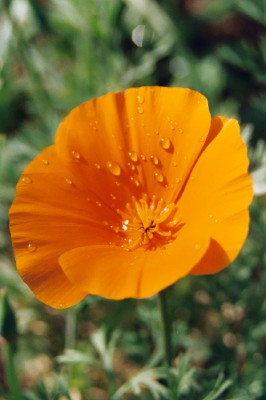
I'm over-run with Californian poppies, from a batch sown in my first year here and revelling in my dry sandy conditions ever since. I love their sunny orange flowers, and always end up with a few which turn up excitingly different shades from white to pink just to liven things up a bit. But they do form great thickets of seedlings, all deeply rooted with a carrot-like taproot and taking a bit of digging out.

Then there's Phacelia tanacetifolia, again from a few seeds I popped in in the first year I was here (when I relied heavily on annuals while I was waiting to see what else there was in my newly-acquired garden - answer, not much, unfortunately). This is a big, lush, sappy plant with really wierd powder-blue hairy tails for flowers, and grows like mad so it overpowers everything near it. I do love it, but it's done for too many of my more precious plants for me to want to encourage it too much.

Another much-loved self-sower is love-in-a-mist, Nigella damascena. As well as the usual - but nonetheless beautiful - blue, I have a gratifyingly large number which come up that stunning white, sometimes with blue throats, and I just adore them. They are terrible little hussies, though, and scatter seeds indiscriminately and in their thousands.

This year I've also had the delight of a new self-seeder - Cerinthe major "Purpurascens". I germinated about 10 plants of this last year from a free packet of seeds, and fell for them big time. There's something about those big, luxurious mottled leaves and the sultry dark-purple nodding flowers that's a devastating combination. Well - they seem to like it here, which is fantastic, so I've left in a dozen or so where I think they look best, and either moved some of the others or... difficult to do, this, and demands the hardest of gardening hearts... put them on the compost heap.

These are the ones I need to control, though you might also add forget-me-nots which are gradually gaining more and more of a foothold. I'm encouraging them this year, though, because of the newly-planted tulips, so I'm being a bit kinder to them just for this one season.

The others, though, will be subjected to the Christopher Lloyd treatment: he advises weeding out around 99% of your self-seeders, which always seems horribly brutal. I just know I'll congratulate myself come summer, though, when I can enjoy my lovely uninvited guests without cursing their numbers and wanting them to go away and leave my more cultivated party-goers alone.

Sunday, November 19, 2006

Late-season planting

I was expecting to have finished my planting until spring by now - but to my surprise, an order I put in for the next leg of the Christopher Lloyd border turned up just a couple of days after I'd placed it. All credit to Beth Chatto's wonderful nursery - but it meant I've had a hectic weekend getting the plants in as soon as I could after getting them.

So I've now added to my increasingly packed border:
  • Helenium "Moorheim Beauty": The classic Helenium, burnt bronze and copper in a strong, long-lasting daisy.
  • Papaver "Goliath Group": Another classic, this time the reddest oriental poppy you can think of.
  • Santolina neapolitanum: Silver filigree leaves and pompoms of yellow in summer. Not usually my kind of plant, but I'll take a punt on it, and besides I know it'll do well in my dry conditions.
  • Libertia peregrinans: part of the structural planting of the border, a lovely greeny-yellow evergreen that puts up spectacular flowers, too.

I've only got a few more of the main structural plants to put in now, and then it'll be a matter of putting in the annual contingent and waiting for the perennials to beef up a bit. It's all coming together easier and more quickly than I'd hoped!

Thursday, November 16, 2006

Plant of the month - November

Prunus subhirtella "Autumnalis"


This is the view outside my front door at the moment. The mature winter-flowering cherry in my front garden has many virtues - flowering all through winter being one of them - but for two weeks in November each year, it catches fire. Palest yellow in the lower leaves darkens to burnt orange at the centre and erupts into richest red at the top. Utterly gorgeous.


Wednesday, November 15, 2006

Coming up roses

The construction of my little tribute to Christopher Lloyd continues... I got my roses in the post today from Peter Beales, all very exciting as I ordered them at the Chelsea Flower Show. Gardeners are patient folk - can you imagine anything else where you pay for something for delivery five months later...

Anyway - I whipped out this afternoon to get them in the ground as soon as possible. The "conventional" one is Rosa "Perle d'Or" - lovely old-fashioned scented shrub rose. Then I've indulged my passion for species roses, in my opinion criminally under-used. These are fantastic roses, super-reliable and tough, and without the "blowsiness" of the cultivated types. I know most people want romance with their roses, but they're fantastic plants in their own right if they're allowed to show what they can do. Just look at a Rosa canina (dog rose) scrambling through a dense hedgerow and putting out its shell-pink blossoms - or Rosa alba, also known as the White Rose of York, which has to be the toughest rose I know. It grows happily in shade and on poor soils, making it a really valuable rose for people who can't usually grow them.

My two species roses are Rosa setipoda - mainly for its long, wierd hips in autumn - and Rosa pimpinellifolia, an ancient low-growing variety with black hips. The hips are actually one of the best things about species roses - they haven't had them bred out of them so they keep them well into autumn. It rather puts the lie to the idea that roses have a short season.

The only disadvantage is that they're all, without exception as far as I can tell, extremely prickly! Rosa pimpinellifolia's other name is Rosa spinosissima, which says it all really. I'd better invest in some heavy-duty protective clothing when pruning time comes around...

Friday, November 10, 2006

Tulipomania

Haven't had a moment for the last couple of weeks as every five minutes I've been shooting outside to plant a few more tulips.

It's just the right time of year, so I've bought myself nearly 100 bulbs to plant. That sounds like a lot but it still won't quite make the carpet I have in mind - the plan is to add to it gradually over the years. I've got white Triumphator, purple Purple Prince and fabulous scarlet Apeldoorn, all planted in blocks of colour.

I've underplanted them with forget-me-nots, which grow in self-seeded clumps in my garden but have never really been allowed to come to the fore before. I've hit on the rather handy trick of transplanting a little clump onto each tulip bulb, reminding me where the bulbs are without having a graveyard full of labels everywhere.

With luck, I'll get away without digging them up every year since I have sharply-draining light soil, so there's no danger of rot. Just hope there's enough nutrition in there to keep them flowering from year to year. We'll just have to see.
Related Posts with Thumbnails