Sunday, August 03, 2008

Colour, colour and more colour

Just got back from a week's holiday in the Isle of Wight - lovely, thanks, and more of which later, but in the meantime I had a few pics from the Thompson & Morgan open day in Suffolk which I went to just before I left.

Now this is something of a fixture in most garden journalists' calendars but it was the first time I've actually made it along. Bedding isn't really my thing so I hadn't really made it a priority before. How wrong can you be.

Now I'd better declare a blatant attempt at bribery on the part of the T&M people, armed as they were with oodles of freebies and a slap-up lunch. But - honest guv - I didn't really need all the buttering up. This was an amazing display of gorgeous flowers which just bowled me over.


Not that there wasn't any good old-fashioned traditional bedding: in fact there were buckets of it, including many in those awful gaudy candy-pink shades that old ladies love so much. However - stay with me here: in among the god-awful colour clashes there were some superb plants: ones which caught my eye included Begonia boliviensis 'Bonfire', in sizzling, sultry red, and much more subtle greeny-yellow Petunia 'Susanna' - as cool and reserved as the begonia was in-yer-face.


And here's a close-up of the sexiest fuchsia ever - Fuchsia denticulata. I love species fuchsias. Must collect some more.


Bedding outside - they don't bother with subtle colour combinations, do they? But don't you love that millet (Pennisetum Purple Majesty)?


And here's a close-up of the Nicotiana - it's N. suaveolens and planted en masse like this creates an ethereal, airy effect like dancing fairies.


I liked this nasturtium, too - a sultry red with purple-tinged leaves called 'Cobra'. They gave us a packet of seeds in with the freebies so I'll look forward to growing it next year.


These sunflowers ('Irish Eyes') made me smile, too. They were a bit small for my liking - about thigh-height - but looked great in a big massed planting like this.


My only complaint was that we didn't get to see more of this - the trials field, where T&M develop their new varieties, so you get a sneak preview of varieties in development. Quite apart from anything else, the whole (highly commercial) process of breeding new variations that might become tomorrow's stalwarts is fascinating.

Still - maybe next year! I haven't even mentioned the fruit & veg, either - lots of great ideas (standard-trained fig, anyone?) The trials are open to the public too - T&M's open day has been and gone, but all the major seed companies do it so get along to one if you possibly can (even if you are a bit sniffy about bedding!)

Tuesday, July 22, 2008

Didn't we have a luvverly time...

I promised you some pics of our weekend at the Great Gardening Show at Loseley House - so here they are...


Our humble little corner - that's my hubby and dog looking rather lugubrious (or is that just embarrassed?). We sold quite a few of those nice oak boxes and got lots of interest in the garden storage solutions. Quite a hot topic at the moment, it would seem (all the better for our bank account, then).


Then I set off to have a look around. Got very excited about these "hanging bamboos" - finally, I thought, I've found a way of using bamboos that keeps them in their place. But then I found out they're not bamboo at all but a grass - Agrostis stolonifera. I suppose bamboo is a grass, strictly speaking, but I think my campaign to outlaw the stuff continues unabated.


Loads and loads and loads of flowers everywhere - I thought this display was a riot...


...and so did the bee, which took absolutely not a jot of notice of me while I took this photo. Far too busy. As you would expect, from a bee.


This fig tree was on the rather wonderful stall from Plants On Line. They had some fabby citrus and olives too (I'm a bit obsessed by exotic-ish edibles at the moment as I'm cooking up a scheme for my garden - literally...) And a few pomegranates, which is another tree I hanker for. Apart from their rather regrettable predilection for bamboos, this is a seriously good nursery which I hadn't come across before.


Further indulging my edible exotics fetish, this is my must-have plant for this year: I spotted loads of colocasia at Hampton Court and this one was a beaut. Just look at those leaves... the edible bit is the tuber, which tastes a bit like potatoes so they tell me. I'd like to know who digs up £20 tubers to eat, mind you...


Last but not least, on the same stall as the colocasia (that's Athelas Plants - another fantastic exotics nursery) was this gorgeous Anizoganthus in full flower. It's called 'Gold' (can you tell why?): don't know the plant well but apparently it's not that easy to get it to flower like this. The label tells me it needs sun and well-drained soil - might do well in my acid sand, then...

My "must-grow-before-I-die" list is getting longer and longer. Better make it to my Queen's telegram otherwise I'll never get through it at this rate.

Saturday, July 19, 2008

It's showtime!

I'm seeing life on the other side of the garden show stand this weekend - I'm actually an Official Exhibitor for the first time ever!

Here's a rather gratuitous pic of my pass to prove it:


As I've never done anything like this before it's probably more exciting than it ought to be but I don't care, I'm really enjoying myself. It's at the Loseley House Great Gardening Show, which is an annual event that's become a local fixture round here - though I must admit it hasn't been as packed as in previous years, no doubt something to do with the impending recession.

Anyway, this is all thanks to my rather talented hubby who's just jacked in his job and turned a 20-year hobby into a business, making all sorts of garden carpentry (shameless plug for business via his website here). He booked a stand some months ago - it started out as a stand for a wendy house but then he got into all sorts of other things woody as well so we've got quite an eclectic mix. And a few plants of course - I schlepped off to my local nursery, Spring Reach (another shameless plug there) to scrounge some pretty roses and rather nifty standard-trained cotoneasters on last-minute loan to tart the whole thing up a bit. Business has been pretty good so far, and we've still got a day to go - hopefully will get around to a few proper pictures tomorrow.

Thursday, July 17, 2008

End of term

I thought you might like to see my model...


No, it's not a random collection of toilet paper, cotton wool and lollysticks, but a state-of-the-art 3-D representation of a town garden. Oh, all right then, it is a random collection of the bits other people throw out, but I had a fabby time putting it together.

This was the grand finale of the Capel Manor Drawing & Graphics course, which finished today - or rather, today was the deadline for handing in the coursework, which I managed by the skin of my teeth (was frantically cutting up chopsticks with my Felco no 9s over breakfast to make the pergola legs). It wouldn't win any prizes, but it's such a long time since I made anything like this that I just had a blast.

The whole course has been a bit of an eye-opener, in fact: can't believe it's finished already, it's gone so quickly. I discovered that I'm not all that good at drawing, though can turn out a passable stab at something recognisable if coerced: but much to my surprise, I do really like graphics, especially the pen work which is fiddly but very satisfying. I think it had a lot to do with being able to see the point of things - being a very prosaic sort of person, I could happily sit for hours drawing Very Precise Circles for planting plans whereas I got a bit impatient with all that painstaking shading and "just let yourself free" arty-farty stuff.

I was reading a recent issue of Gardens Illustrated (one of my favourite magazines) which has a column by the novelist Frank Ronan in the back (ashamed to say I've never read any of his novels, but he can sure can write about gardening). One of his last bon mots on the subject of "what is a garden" was "The gardener starts with a plant, not a pencil."

Precisely.

Tuesday, July 15, 2008

July flowers


I decided to join in with the Garden Bloggers' Bloom Day this month - this is the first time I've ever created a slide show, so be gentle with me!

You can see everyone else's spectacularly gorgeous gardens at May Dreams - go check them out, it's a real celebration of summer.

Monday, July 14, 2008

All change

I'm having to say goodbye to my weekly gardens at the end of the month. I've been offered a peach of a writing job which I can't really say no to - but something has to give, and it's the gardens that must go, sadly.

Not that I'm giving up gardening - no sir. I'm still doing my "big" gardens - those projects I'm working on involving an element of design or re-working. And then there's my own garden, which I'm cooking up a scheme for - involving more exotic plants than I strictly speaking ought to give houseroom for (but I just want to have a go at growing them).

It's a great opportunity for me, but I must admit to a bit of sadness as I trim hedges and weed borders for probably the last time. You get to know gardens intimately when you spend hours every week there - and you kind of forget they're not yours. So it's a wrench to leave them (and I keep thinking things like "I hope whoever comes after me keeps up with the mulching..." or "I must do that overgrown Philadelphus before I go or it'll never get done".

It's hard to let go.

Thursday, July 03, 2008

Plant of the month - June

Geranium 'Ann Folkard'


Well... actually, this might be G. psilostemon, but I don't think so. I've lost the label (as with so many of my plants) and my memory of writing 'Ann Folkard' somewhere is hazy, but extant.

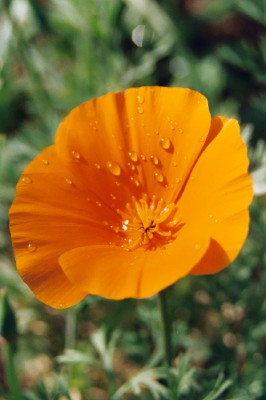
Anyway, this gorgeous floozy has taken a while to get into her finery, suffering as she has from far too much competition in previous years while she was trying to establish herself. I belatedly realised this last year so she got a nice year free of anyone else trying to outdo her, and has rewarded me this summer with the most unbelievably spectacular fireworks of in-yer-face magenta pink. She's forgiven her thuggish neighbours to such an extent, in fact, that she's now clambering among them lovingly, brightening them up no end with her lipsticky kisses. It's brought some eye-popping combinations - magenta and orange anyone? (this one when she wrapped herself around a neighbouring Californian poppy. It looked sensational).

Magenta pink isn't usually my thing, but Ann does it so well, and somehow it just looks right, giving the border real pizazz week after week. Hardy geraniums are generally good do-ers, and the fact that this one has managed to survive three years of suffocation and still come through it smiling her head off is testament to just how tough she is. I haven't watered, cut back, or in any way given her the attention she so clearly deserves - yet she rewards me with this. I think it means she's forgiven me, so I'll make it up to her with lots of TLC from now on.

Wednesday, June 25, 2008

The Bamboo Uprooting Movement

That's it - I'm officially launching the BUM.

I'm still nursing my wounds after having to deal with a client's rampant black bamboo (Phyllostachys nigra) - don't believe 'em when they tell you it's clump forming: it is, but only if you want clumps six feet or more across.

Now I've been collared by my next-door-neighbour wondering what these big hefty weeds growing in her garden are. It turns out that when the next-door-neighbour on her other side had his garden re-designed, the designer (who should have known better) scattered bamboo willy-nilly through the otherwise well-planned borders - and crucially, along the dividing fence between the two gardens.

The bamboo has now decided next door looks kind of nice too, so it's making a bid to colonise my poor neighbour's garden. This is what happens when a garden is designed without consideration for the fact that it's a garden: i.e. it grows, and some plants grow more politely than others.

Bamboo is a very impolite plant, has no respect for borders, or anything else for that matter. It sends out runners as thick as steel hawsers - and as difficult to get out - that then send up huge canes which you simply can't ignore or live with - or get rid of. I believe it should be classified as invasive, in the same bracket as Japanese knotweed. After all, no doubt the Victorians thought knotweed gave borders height, stately elegance and architectural beauty when they brought it back from the Himalayas in the 1800s - and look where that got us.

I'm now wondering whether I'll cause a civil war if I advise my neighbour to do something unmentionable involving cutting a stem and pouring something lethal down its hollow middle. Please - don't find yourself in the same situation. Get it out of your gardens. Now.

Tuesday, June 17, 2008

How to make a coldframe #4


Time to get back to my coldframe construction - it's been put on the back burner a little since all the blessed weeds started growing in about April. I'm currently juggling with a Heath Robinson construction of planks and old greenhouse glass next to my greenhouse as the home for my long-suffering seedlings (late-sown summer annuals, mostly) - I do wish I could get on and finish the deluxe model. At this rate it'll be just about ready for the first frosts...

Anyway, I think I left this just as the uprights were nicely battened and ready to clad. You start by doing the end uprights, the ones you put battens around the inside edges as well as at top, back, front and base. The reason for these inside battens will now become obvious: these are what you fix the cladding to.

This is a pretty easy process: you can either use thin planks, like I have, or following the Terence Conran design more closely, you can use overlapping cladding, which is kind of wedge shaped and widely available from DIY stores. I originally thought this would look a bit clunky (actually I still think that) but now I think it might be the better option - the above looks smart, but it does inevitably mean tiny gaps between the planks, as wood rather inconveniently tends to move as it gets soaked or dries out. Cladding, on the other hand, can move all it likes but it's still overlapping, so no draughts.

The only slightly tricky bit is cutting the top triangular wedges to size: the best way is to draw the shape of the upright onto the planks as a cutting guide before you actually nail them on to the battens. Or you can do it like me, and fiddle about cutting extra bits off here and there as you go along, thus doubling the time it takes you and making you swear in frustration.

No prizes for guessing that we'll be cladding the rest of it next time.

Previous bits of the series:

How to make a coldframe #1

How to make a coldframe #2

How to make a coldframe #3

Wednesday, June 11, 2008

Novelty value

I found out what my mystery honeysuckle is today!

I eventually got around to taking a sample over to Wisley's spectacularly useful Advisory Service a couple of weeks ago. For those who don't know, this service is perhaps the most useful thing you get along with your RHS membership: you get to take any problem, and any unidentified plant along to your nearest RHS garden (or you can send it in) and you have instant access to the country's leading plant experts to identify it for you. I always have the "I'm not worthy" feeling when I go in there - why would they want to be bothered with my humble little garden? - but they're unfailingly friendly and extremely helpful.

Anyway - back to the honeysuckle. It turns out to be Lonicera xylosteum - a new one on me. In his email the RHS botanist tells me it's "a native shrub sometimes known as fly honeysuckle... It normally forms a medium-sized, deciduous shrub producing small, creamy-white flowers in early summer. These may be followed by red berries in the autumn. Although of very restricted native distribution, it is grown in gardens and has become naturalised throughout the country."

I love having an Unusual Plant in my garden. It makes me feel like a trustee of something important - something to do with there not being that many around, but one of them's in my garden. I'll get ideas about National Collections next...

Monday, June 09, 2008

Beauty in unexpected places #2


This lichen was clinging to an ancient apple tree on the Trevarno Estate in Cornwall (yes, I'm aware that I've banged on about this lovely garden before). It was in the walled garden - currently being restored to its former glory, and including a few remnants of the old Victorian kitchen garden it once was.

Lichen is a thing of total, wonder-inducing beauty if you look at it closely. It appears on older trees and lots of people think it's doing damage - in fact it's just a sign that conditions are perfect, which means damp and a little shady with a nice bit of roughened wood to cling on to. Those little tufts of hairy grey moss just add to the general sense of other-worldliness, don't you think? It could be a scene from the surface of the moon.

Monday, June 02, 2008

So, then, that was May...

May is a write-off for me every single year. I always seem to leave normal life somewhere about mid-spring, and then wake up again when the summer's arrived, slightly bewildered and wondering what hit me (and the garden, which is by then knee-high with weeds).

The main reason for this is a particularly nice one, which is the massive workload I get in the run-up to and during the Chelsea Flower Show. I go there every year with a much-prized press ticket and have a ball. I loved it this year as much as ever: you don't need me to go on about which garden was best (plenty of others have done it better) but all I'll say is that my favourite won it. I had Cleve West's lovely confection as an outside bet for best in show - he said he was hedging his bets by making one side a tapestry of rich, purple-and-burgundy colour while the other end was all soothing greens and whites. I thought it just meant you had two gardens in one, so double the bang for your buck, so to speak. The amazing thing was, it held together as a whole, too, which is quite a feat.

The only other thing I'll go on about is the Great Pavilion, which is by far my favourite bit of the show, and the bit that makes me feel most humble. Avon Bulbs, Hilliers, Barnsdale, Kirstenbosch, Grenada, David Austin... the roll call of my all-time favourites is nearly the same every year, but there is a reason for that: these are the ones you can depend on to put on an exceptional show of horticultural fireworks, and you always come away bursting with new ideas and marvelling at new plants.

Anyway, that's quite enough of a show long past now. I brought my annual souvenir away too: I've been buying a plant from a Chelsea garden every year since I started going. So far the tally is a Helictotrichon sempervirens (2006), a Heuchera 'Brownies' (2007) and this year two: a shining silver Astelia and (impulse buy this one) a fabulous purple-and-green canna which cost me six quid for a five-litre potful from the confusingly-named Gavin Jones Garden of Corian, which was alternatively titled "Elevations" and was in fact designed by Philip Nash - dunno who Gavin Jones was. The garden was OK - not my favourite style, as it was kind of modern and spiky with lots of white hard landscaping mixed with steel and glass - but the planting was fantastic, with a really rich textural mix of exotics and unusual forms of more commonplace plants. I loved (and nearly also bought) the Pittosporum tobira 'Nanum' they used and it's now on my list of plants I must grow before I die.

But there I go, on about Chelsea again, and it's a week gone by since the last day. Back to work, back to the hedgetrimmers... normal life again.

Friday, May 16, 2008

Magnolias at Kew

Yes, I know it's long past magnolia season but I thought I'd just recall for everyone just how lovely these trees are. My excuse is that I've been having a bit of a magnolia fest this year, as not only did I get to write a whole article about them which included talking to some of the country's best growers and enthusiasts but also got to see the National Collection down in Caerhays which got me totally smitten - especially this fine specimen.

Well, just a few days after I got back from Cornwall I was over at Kew on another journalistic jaunt (I do love my job) and while wandering back from doing my interview, went to have a look at the magnolias. They'd been rather clobbered by frost, unfortunately - occupational hazard if you're a magnolia - but there was still enough there to make me swoon.


This one was amazing (and this pic is now my desktop - VP take note, I've shown you mine now too!). This is M. 'Phelan Bright', and these flowers are 10" across. Pretty amazing anyway, but even more so when you consider the tree is only 3 years old (some magnolias can take up to 20 years to flower).


Sadly this lovely thing was just about the only flower on the whole tree not reduced to brown and tattered ribbons by frost. Made it all the more special that this one survived. This is M. heptapita 'Yulan' - I'd never heard of the species, but the flower colour was the purest white of the lot.


Magnolias aren't often praised for anything except their flowers, but the buds are just gorgeous (fuzzy brown nutkins you can't help but stroke) and the leaves are often spectacular too. None more so than the leaves of M. grandiflora - it's evergreen and as you can see has lush, almost tropical foliage.


I love magnolias for their branch structure and their habit of flowering before the leaves come out - yes, it exposes them to frost, but it also shows you how spectacular pure white flowers against the stark outline of a tree trunk can be. This one is M. x veitchii 'Alba'.

Note to self: plant another magnolia. I only have M. stellata but every time it comes out in my front garden it looks more spectacular and I promise myself I'll get another one soon.

Wednesday, May 14, 2008

Drawing conclusions

I've spent a lot of time drawing lately.

Last night I was drawing an onion. The other day it was my hand, closely followed by a large director's chair on a table.

What this has to do with gardening I'm not quite sure - but all I know is it's great to be the one nicking the pencil sharpener out of the kids' art box for a change.

It's all to do with the Drawing and Graphics course I've now started at Capel Manor. Lovely teacher, great fellow students (all of whom are well into gardening so I now have lots of new friends to discuss the pros and cons of coppicing eucalyptus with), and I'm learning a great deal about negative space, tonal drawing and the value of a 4B pencil.

Can't quite see the connection between director's chairs and garden design yet - but am willing to suspend my disbelief for the luxury of being given permission to draw pretty pictures and call it work.

Wednesday, May 07, 2008

Beauty in unexpected places


This was the scene a few weeks ago at a road junction where I live. It's the most unpromising place - a corner between one main road and another pretty busy minor road - and it had roadworks opposite and traffic to right and left. But in the middle was this stunning display of spring sunshine. I wasn't the only one taking photos - it would put a smile on your face in the worst traffic jam ever!

Monday, May 05, 2008

Scary gardening

I got called a scary gardener the other day. That was by a client of mine when she saw what I'd done to her forsythia.

The trouble is, I keep getting asked to put right the effects of years of neglect. This inevitably means reducing large, overcongested shrubs to a fraction of their original size and density.

This is of course very good for the shrub: you cut out all the dead wood that's been suffocating it for so long, you let air and light into the centre from where it'll send up lots of lovely new young shoots (especially now it has room to do so), and particularly in the case of this forsythia, you restore some of the natural shape to the plant. The forsythia in question had been given a haircut once a year for several decades, which involved clipping the top to a blobby kind of dome shape and cutting off a large proportion of next year's flowers in the process. The centre of the shrub was so congested you couldn't see between the branches, and it had also more or less stopped flowering.

In my defence, I had intended to go quite easy on it - forsythia don't normally enjoy being very hard pruned, so I usually only remove a couple of the thickest branches. But in this case the decision was made for me: once I got up close and personal with the centre of the shrub, I discovered that at least half of it was dead. Once I'd removed that, there was a bloomin' great hole in the middle, so in the end the only live branches I had to remove were to re-balance the shrub again.

Result: a much healthier, but much reduced forsythia. The owner came out to see what I'd been up to, and gasped.

"Oh... my.... god.... " she croaked, for some reason clutching her throat.

At this point I began stumbling over myself in my haste to reassure her that it would be much happier now, produce lots more flowers next year, would actually move in the wind rather than just sitting there in an approximation of rigor mortis... etc etc etc. Whereupon she called me a scary gardener.

Well... I shall be suitably smug next April and May when it's smothered in tons of yellow flowers. Honestly, it's a good thing I don't require any thanks for this job....

Friday, April 25, 2008

Plant of the month - April

Amelanchier canadensis

Snowy mespilus


Actually this picture was taken a couple of weeks ago, and the blossom has finished since, but for all that its spectacular display is brief, when snowy mespilus flowers in spring it really steals the show.

These delicate, butterfly flowers are far more graceful than cherries: they're less overblown, less in-your-face, far more comfortable in their own beautiful skin. These are not flowers that need to shout their arrival: they just appear one day, and everyone drops what they're doing to stare.

One of the most lovely things about the snowy mespilus blossom is that it appears against the very young growth of the leaves, which at this time of year is tinged a coppery bronze. The combination will take your breath away. This is in many ways the perfect small garden tree: it will now clothe itself with vibrant pale green leaves all summer, provide striking purplish-black berries in autumn, and shed its leaves with a final flourish of vivid orangey-reds. It never gets too big, or too messy-looking, and it's not too fussy about its soil - it even puts up with my free-draining sand. If you don't have a mespilus in your garden, go out and buy one right away: you're missing something very special.

Wednesday, April 23, 2008

Those were the days...

While I was in Cornwall (told you I'd be going on about it a bit) I popped into the National Gardening Museum at Trevarno, near Falmouth (which is itself a lovely garden - the bluebell walk was in full flower and a welcome respite from the gale-force winds knocking us off our feet everywhere else).

I've only ever been to one gardening museum before - the one everyone's been to, the Museum of Garden History in London. That was a few years back now, and all I can really remember of it was the utterly charming knot garden nestled in behind it - which made it more of a garden visit than a museum visit really.

The National Gardening Museum is less charming, in that it's housed in a rather post-industrial barn-cum-warehouse, so it's best not to look up too often. But what it contains is utterly absorbing and quite surprisingly fascinating.

Garden museums seem to be largely about tools and sundries, not plants, unfortunately, but you do realise there's a story behind each one. I happened to be walking around behind a group of old boys, who kept remembering having used half the things on display. There was a quite absurd number of watering cans, some sinister-looking spray guns, and I'll never view gazebos in quite the same way again after seeing the Victorian version.

But most fascinating of all, to me, was the display of seed packets. Again, it's something you take so much for granted - yet did you know Suttons used to supply their seeds in what they called "close cases" - glass test tubes to you and me, bunged up with a stopper and presented in a sort of large cigar case, beautifully and with much ceremony. Even the labels had a touch of mystery and gave a real feeling that here was a little pot of gold dust.

It makes you feel the romance has gone out of gardening a little these days - I can't imagine them making a display out of your average Suttons seed packet circa 2008. I could be mistaken, though - no doubt we'll all get our seeds virtually in times to come, teleported magically into our gardens with not a seed packet in sight. Now there's a thought...

Monday, April 21, 2008

Close encounters of the horticultural kind

Just sometimes you meet a truly, truly memorable plant. The kind of plant you just know you'll think about for the rest of your life, in an "oh yeah... now that was amazing" sort of way.

This happened to me last week, while on holiday in Cornwall (of which much more later). The plant in question was a Michelia doltsopa in Caerhays - a fabulous garden, with a National Collection of magnolias and their close relatives, which include the Michelia family.

Now, I discovered while doing a bit of research for a recent article that this not-very-commonly-grown tree is causing some excitement in magnolia-growing circles (not very mainstream, admittedly) - since one of its close relatives (M. yunnanensis) in the process of being recategorised as a magnolia. Well - all I can say is, you might think magnolias are spectacular - but cop a load of this.


(my eight-year-old doesn't much like having her photo taken)... and every single one of those millions of flowers looked something like this:

You could walk right inside the tree, and in the centre, too, this was a magical, architectural, unforgettable plant:


And as if all that wasn't enough, the whole thing was scented - a rich, musky, sultry scent that went right to your head. Magnolia fans - eat your hearts out.

Monday, April 07, 2008

Don't Panic!

One of my clients has a small but much-loved bay bush as the central focal point in a rather pretty little raised herb bed made of sleepers sideways on in a diamond pattern.

She rang me the other day in a right panic, insisting it was dying. It's always suffered mildly from vine weevil, which we've been keeping under control with a drench - but she was now convinced the little beggars had got it. So I promised to go and have a look.

The trouble with diagnosing plant problems is that it can be a bit like looking at those medical dictionaries which convince you that every time you have a headache you're about to die of a brain tumour. I realised as soon as I saw our little bay tree that it was a long way from dying - but then I started double-checking, just to make sure, and came up with a whole hypochondriac's litany of ailments, any one of which could turn out to be fatal.

Yes, there were plenty of glossy green leaves on it, and if you looked in the centre of the bush it was a deep, healthy green with lots of dense young growth. My client had panicked over some patches of yellowing leaves, which were rather undeniably a nutrient deficiency, and more specifically nitrogen deficiency. Remedy: a dose of liquid feed once a week until it's perked up a bit. Nothing more serious than that.

But look... some of the yellowing leaves have dark brown edges... and a curious dotting all over them. Hmm... I wasn't aware that bay could get rust, though that's exactly what it looked like. I decided I'd better look it up, just to be on the safe side.

Big mistake. Much like picking up that medical dictionary, I now have half-a-dozen horrible fates to consider for this poor little tree. It might have bay sucker - a mite that causes the edges of leaves to blacken and curl over. No curling on the leaves of my bay tree, mind, but then it might be early days... Now I discover that there's a new pest of bays, called bay rust mite, which only arrived on our shores last year after migrating from its usual home in the Med. As I read about black necrotic spots on the leaf surfaces I got really quite excited - rare diseases are almost as much of a buzz to discover as rare plants. Unfortunately (or fortunately, for my client) I discovered a picture of them on the Central Science Laboratory's plant newsletter - and it looks nothing like my bay leaves at all.

So for the moment I'm keeping my fingers crossed and betting on the odds-on probability that all we have here is a hungry bay tree with a mild vine weevil problem. I'll dose it with vine weevil killer again and give it a nice slosh of seaweed pick-me-up and see if it turns the corner. If not, I'm afraid it may be terminal.

Tuesday, April 01, 2008

How to make a coldframe #3


Right, now having blown your brain cutting impossibly shallow angles for the upright dividers (I hope it wasn't that bad - I "borrowed" my husband's professional shed-making machinery so I cheated)... now here's an easier bit of woodwork for you.

The battens you attach to the uprights are to hold the cladding in place, and should measure 25mm x 25mm, though I couldn't find that at my local branch of Wickes so settled for 25mm x 38mm. As you can see from the pic you only need them along the top edge and down the two vertical sides of the dividers - not along the bottom. You'll obviously need the battens on both sides of the two central dividers.

You do need to cut the top batten to shape at an angle, but it's a lot easier this time. Use the edge of a bit of cut-off batten wood as a spacer to work out how far down you need to attach the batten itself (if you're using 25x38mm wood, use the 25mm edge). Just line the spacer up with the top edge of the divider and draw a line underneath. This marks where the top edge of the batten will go.

Then cut the batten to about 10cm (4") too long at each end and nail it on so that it lines up with the mark. After that, it's just a matter of cutting the ends off flush with the divider.

The upright battens are far easier - unless you're a real perfectionist (or are borrowing your husband's shed-building machinery) you don't need to cut the ends at an angle as they go in pretty close anyway, certainly close enough to fix the cladding to. You do still need to do the thing with the spacer, though, or the cladding won't lie flush with the uprights.

After you've done all that, you'll also need to put in an extra bit of battening all around the inside edge of the two end dividers - the divider in the picture is an end divider, so you can see how I've done this if you look closely. This is so that you can attach the cladding across them to form the ends of the coldframe. Again, you don't need to be too exact - just cut the battens off straight and fit them in as snugly as you can.

I'll get on to cladding the ends next time, and all this will hopefully start to make a bit more sense.

In case you missed the previous bits of this inordinately long series, here they are:

How to make a coldframe #1

How to make a coldframe #2

Thursday, March 27, 2008

Crossing over

It's not often you find a gardener who's a designer. Or, for that matter, a designer who will readily admit to being a gardener: the best ones will usually be keen gardeners in their own gardens, but professionally there's not much cross-over between the two.

As time goes on, though, I'm finding the lines are becoming increasingly blurred for me between professional gardening and designing. I've had two regular clients ask me to design their gardens, or bits of them: one is a clear-ground project which will probably take years as we're doing it mostly by hand; the other is a perfectly good garden at the moment which they're about to rip up for an extension, so it'll need a re-work afterwards.

What's more, a designer I sometimes work for as a gardener has now asked me to help her out and design part of two of her clients' gardens - they've asked for veggie gardens and she doesn't know much about vegetables.

So all of a sudden, I find myself being a professional gardener and a designer.

Well that got me thinking. I actually really enjoy designing with plants - not so keen on the concrete and garden furniture bit, but love the idea of putting my favourite plants together so that they really sing. I've started to wonder if I might be able to break the mould a bit, and wear two hats at the same time - professional gardener, and plant designer.

To that end (and so that I'm not entirely talking out of my backside when asked to do these projects) I've signed up for a college course at Capel Manor College in London. This is one of the better design colleges, and to its great credit has a garden design course that concentrates solely on plant design. I'm starting by learning how to draw (never a great strength of mine) - first lesson at the end of next month. Wish me luck!

Tuesday, March 18, 2008

Plant of the month - March

Hyacinth 'Delft Blue'


I had always thought of hyacinths as the sort of flower your grandma grows. That is, until I saw them in the late great Christopher Lloyd's border at Great Dixter. As regular readers will know, I'm a big fan of Mr Lloyd's, so anything that's good enough for him is good enough for me. When I went, he had 'King of the Blues' in his Long Border, and it truly zinged out at you from among the spring flowers - not gaudy, as some over-bred primroses are, for example, but just pure, joyous blue.

I couldn't find 'King of the Blues' so had to opt for 'Delft Blue' - a more commonly-grown type but nonetheless superb for that. At this time of year its uncompromising china blue stands up beautifully to the butter-yellow daffodils all around it - this is not a wishy-washy plant, and all the better for it. You can force them to grow indoors - the usual excuse is to enjoy the scent at close quarters, but to be honest I find it overwhelming and a little sickly in the house. Far better to have it scattered on the wind so you catch a little puff of it as you pass by - one of those utterly blissful moments that gardening is all about. It seems grandma knew a trick or two after all.

Wednesday, March 12, 2008

Pruning as art

I'm well into the March pruning season now - have so far tackled dogwoods, coppiced eucalyptus, hebes, mahonias, hydrangeas, buddlejas and an overgrown berberis (that one was as truly horrible a job as it gets). I have yet to take the secateurs to a deciduous ceanothus or two, a cotinus, a small field of hypericum, and several pyracantha. I'm sure I'll spot a few more before I'm done.

It took me quite a while to realise that pruning is an art form (and I'm not talking about the really arty stuff like cloud pruning or topiary - just common or garden keeping your shrubs in check pruning). One injudicious snip and the balance of a shrub is ruined - usually if you chop off a branch you weren't intending to you actually end up starting again, as you then have to re-balance the shrub to make amends for your mistake.

So when I'm pruning I take my time. I do an awful lot of standing back and pondering with my head on one side, à la van Gogh (told you it was an art form). This is because once you prune out one big-ish branch, if you take a step back and look at the whole shrub, it suddenly becomes glaringly obvious which branch is now sticking out like a sore thumb and needs to be pruned out as well. Eventually - hopefully - you get to an equilibrium, where all the branches are evenly spaced, there's plenty of air and light in the centre of the shrub, it's not too tall or too wide, and looks just right (if considerably slimmer than when you started).

Of course there are shrubs which provide a little light relief to all this nailbiting judgement malarky - cornus, buddleja and coppiced eucalyptus you can just gaily slash back to a bud somewhere between 6" - 36" above ground level with no thought to aesthetic delicacies. But treat all shrubs with such reckless abandon - as, I find, most white van gardeners do - and you end up with a stubby stump of brushwood which does no aesthetic favours to anyone and won't help the health of the shrub, either. Take three, or even four times as long over doing it, and you'll have not a pruned shrub, but a work of art. It's a creative business, this gardening lark.

Monday, March 10, 2008

Blowing a hooley

I've spent much of today hunkered down in my office, looking out at a scene of wild and woolly weather.

We've had gales of about 60-70 mph here - not quite as bad as the coast, where it's got to 80mph, but quite bad enough. My heart is in my mouth on days like these: with the ground already sodden after a wet winter, the trees' roots are loose in the ground and so vulnerable to a big gust. Luckily - or unluckily, depending on how you look at it - the only casualty so far has been the cherry tree over the road: as you can see, it's lost most of its crown, and it was in full blossom, too. I hear one of the Scots pines in the woods nearby has gone down, too. We're surrounded by trees here, so it's rare that we have a storm and nothing suffers.

I'm old enough to remember the hurricane of '87, and though it's not exactly been that sort of thing today, it's quite bad enough. Then, most of Kew was flattened and we lost some of our oldest historic trees - grown men wept when they first saw the devastation. I'm hoping we won't have any reports of that sort of damage today, but I do also remember that then it was a time of renewal: a lot of plantings that had become stale and tired-looking were rejuvenated as new saplings, often in re-thought designs and in exciting new varieties, were planted to replace the old dinosaurs. As they say, it's an ill wind...

Friday, March 07, 2008

Waxing lyrical

When I'm not out in the garden, or writing about it, it seems I'm listening to things about it... This morning it was a little gem on Woman's Hour, on Radio Four, that caught my attention. It was an interview with garden historian Jenny Uglow in her suspiciously neat-sounding shed (she could get inside it, along with a radio reporter, for a start).

Jenny's delightful book, A Little History of British Gardening, is one of the treasures on my bookshelf. It's full of interesting things, and so was her interview on garden tools - as regular readers will know, I'm a bit of an anorak where the tools of my trade are concerned.

Anyway, did you know, for example, that painting your tools blue keeps flies off? Or that one of the daily tasks for Victorian estate gardeners was squeezing ants?

The report also had a little ditty which I just have to share - I'm sure everyone else has come across it already, but I had the delight of discovering it for the first time:

"From where the old thick laurels grow along the toolshed wall
You find the tool and potting sheds, which are the heart of all.
The cold frames, and the hothouses, the dungpits and the tanks,
The rollers, carts and drainpipes with the barrows and the planks,

And there you'll see the gardeners, the men and 'prentice boys,
Told off to do as they are bid, and do it without noise;
For except when seeds are planted and we shout to scare the birds,
The glory of the garden, it abideth not in words.

Our England is a garden, and such gardens are not made
By singing, "Oh, how beautiful!" and sitting in the shade.
Far better men than we go out and start their working lives
In grubbing weeds from gravel paths, with broken dinner knives."

I discover from Jenny's book that this is actually by Rudyard Kipling - it's called The Glory of the Garden. In case you're interested (the internet is a wonderful thing... but it does also encourage you to go on a bit) there's more:

"There's not a pair of legs so thin, there's not a head so thick,
There's not a hand so weak and white, nor yet a heart so sick,
But it can find some needful job that's crying to be done,
For the Glory of the Garden glorifieth every one.

Then seek your job with thankfulness and work till further orders,
If it's only netting strawberries or killing slugs on borders;
And when your back stops aching and your hands begin to harden,
You will find yourself a partner in the Glory of the Garden.

Oh, Adam was a gardener, and God who made him sees
That half a proper gardener's work is done upon his knees,
So when your work is finished, you can wash your hand and pray
For the Glory of the Garden, that it may not pass away!"

That's quite enough of that - ed.

Wednesday, March 05, 2008

How to make a cold frame #2


Hmm... photography never was my strong point, but bear with me here.

For my mega-coldframe I've adapted the design from Terence Conran's Garden DIY, a very handy little book which has lots of useful projects and explains things simply enough even for novices like me. I've made both my compost bins from a design in this book, and very successful they've been too (when I make the third, I'll put that on here too). So if anything in my description of how to make these doesn't make sense - get the book.

After getting the base right, it's time for some woodwork. This design centres around dividing frames, which are then held together using the cladding. I suspect it will have little structural strength in the long run - i.e. I won't be able to move it much - but that doesn't bother me: if it bothers you, you'll need to work in some stronger connecting pieces to hold the dividers together.

The dividers are made from 2x2 (5cmx5cm for the metrically-minded) treated timber. Measure the depth (front to back) and width (side to side) of the space you have available - the good thing about this particular design is that you can have as many or as few dividers as you like, so the coldframe can be whatever size you wish. Mine is made up of three sections, so I've made four dividers (two at each end, two in the middle), which will eventually be spaced a little over 2ft apart.

For each divider, cut a length to fit the depth, then two more for the uprights: one at 1ft (30cm) and one at 18" (45cm). Finally, cut the length that will slope across the top: it'll need to be the same length as the base, plus about 4" (10cm).

Nail the two uprights on to the base at each end, using 2 3" nails at each joint, driven in at an angle - this will mean the joint is much firmer and won't pull apart.

To set the top rail, lay it across the two uprights so that it rests lining up with their top surfaces, and mark off the angle it lies at. It'll only be a very slight slope. Saw this off so that the top surfaces of the two uprights are now at an angle (hopefully the same).

Nail the top rail across them, using the same angled-nail technique as before, and leaving a length of rail sticking out from each end. Finally, saw off the ends of the top rail so that they lie flush with the uprights.

Next: putting on support battens (you can see a couple in the picture above - sneak preview!)

Monday, March 03, 2008

Grape expectations

I've been digging out big clumps of grape hyacinths (Muscari armeniacum) from a client's garden this morning, where they'd formed great grassy swathes and looked a bit like hairy wigs.
Before you think I've gone entirely crazy - what, digging up spring bulbs in spring? - this is actually a great time of year to do this job. I happened to know from last year that a lot of these muscari were coming up blind - that is, lots of foliage but no flowers. It's a general tendency most spring bulbs have if they're doing a little too well and have formed big, congested clumps. The only remedy is to dig up the clumps and remove about 3/4 of the bulbs, then replant.

The thing about doing it at this time of the year is, you can see the flower buds forming at the base of the leaves, so you can tell which clumps are blind and which aren't. They don't mind being hoicked out and replanted, even in flower - just water them back in and they'll get on with things as if they'd never been disturbed.

Wednesday, February 27, 2008

Plant of the month - February

Libertia peregrinans


I discovered this plant through Christopher Lloyd, who writes about it in his book, "Succession Planting for Adventurous Gardeners" - something of a bible of mine. Anyway, as so often with new (to me, anyway) plants Lloyd suggests, it's quickly become a firm favourite of mine.

It's what they call a good do-er - rarely needs any particular TLC, tough as anything, evergreen - or should that be evergold in this case? - and just does its stuff all year round. It's an excellent plant for structure - I've got it planted between a Spiraea japonica "Gold Mound" and a Pinus mugo, where it retreats into the background a bit in summer and then at this time of the year (and indeed for most of the winter) really shines out. It has a lovely, warm burnished bronzey-gold colour that glows in low sunshine and makes those sword-like leaves shoot up, shining, from the surrounding plants.

Mine is still a young plant, but I'm hoping if it's happy it'll form a nice beefy clump in time. It almost seems like an afterthought, but it does also have pretty iris-like white flowers later in spring, too.

Monday, February 25, 2008

Rambling on

I'm coming to the end of the rose-pruning season at the moment and thank goodness for that - my fingers are full of thorns and my hands are so scratched it looks like I've been washing in barbed wire.

I'm ending the pruning season with a really tricky one, though: in my new garden, there's an old and rather dilapidated trellis fence across the back supporting three climbing roses - or are they rambling roses? That's the problem. The owner knows what one of them is - it's Albertine, which is a rambler, so that's fine. The other two are a mystery, and they're not the same as each other, either.

The difference between a climber and a rambler is quite a subtle one, but has quite an impact on how you look after them. As a general rule of thumb, if your rose is producing lots of whippy stems from at or near the ground, it's almost certainly a rambler: if you can see a framework of branches in the centre, from which the flowering shoots are coming, then you've got a climber.

Of course, there are, as always, exceptions to the rule, and I think I may have one here. The rose on the left-hand side is producing lots of long, whippy stems - but it also has quite an established framework. Now this could be because it's been quite neglected, so the whippy branches have been allowed to thicken more than they usually would - or it could just be a whippy sort of climber.

Oh dear... well, I hedged my bets and pruned it like a climber but leaving more of the whippy bits in than I usually would just in case it's a rambler after all. I shall wait until it flowers and take a sample or two up to Wisley just to find out for sure.

Oh yes, and the difference between caring for ramblers vs caring for climbers? You prune climbers at this time of year, taking sideshoots back to 2-3 buds from the central framework, but ramblers you allow to... well... ramble until August, when you remove one in three of the oldest shoots right down to the ground to thin them out a bit. Climbers, you see, flower on growth made this year; ramblers flower on growth that's matured from previous years. Which is why I'll be in deep doo-doo if I've pruned a rambler like a climber - because I'll have chopped out all those nice mature stems, and therefore the flowers... Well, time will tell, and luckily the owner is very understanding!

Saturday, February 23, 2008

How to make a cold frame #1


Just occasionally I'm not so much a gardener as a builder. When you're developing a garden, the first several stages involve an awful lot of digging, lugging stone around and construction - it all seems to take ages and hasn't got a great deal to do with plants. But if you have the patience to do it, it's worth it.

I've been struggling to manage in recent years without a decent coldframe, so this spring I've decided to bite the bullet and make myself a super-deluxe model, the entire length of my 8' greenhouse and about 3'6" from front to back. This is not small for a coldframe - but then my greenhouse is already groaning with seedlings and I've only just started early sowings, so I do need the extra space!

As you'll see in the picture, the first step, before I so much as banged in a nail, was to sort out the area where the coldframe was to go. There were two blackcurrant bushes here, which were always a bit close to the greenhouse for comfort, so I moved them to the allotment this winter. I had to hoick out a spare gooseberry bush, too - not such a well-thought-out manoevre as I hadn't anywhere to put it. Luckily I've got two more to the right of this area, so I'm not exactly going to go short.

Then I marked out the area and dug it down to half-a-spade's depth. This is a really useful depth for hard landscaping - it does for paths, patios... pretty much anything, really.

Next I edged the area with boards - I used 4" boards, but you can use standard gravel boards which are 6". These were attached to short stakes at the corners and checked for straightness with a spirit level.

I roughly levelled out the earth inside the boards, and then put down some weed-suppressing membrane, stapled to the boards on the inside to about 1/2" from the top (you can just about see the edges in the picture). And, finishing touch, about 9 bags of gravel from the local DIY store. This means you can level it easily, and the coldframe isn't resting on bare earth - which means it won't rot so quickly, either.

Next instalment... the start of the woodwork!

Friday, February 08, 2008

Getting things through the winter

I was checking over my geraniums this week. I've got a few I'm overwintering for myself, plus a few for a couple of clients, and then there's another client who has a whole balcony full of them and needs them all lifting in autumn, overwintering and then setting back out in spring.

You'll hear lots of different methods of overwintering geraniums (I should say, more correctly, pelargoniums), but here's what I do. It's pretty simple.

You take the plants out of the pots they've been in all summer, and pot up in a plastic pot which just fits the roots (i.e. you don't have too much spare soil left over). General-purpose compost is fine - anything too loamy and they get too damp. Then I take the secateurs to them: any leggy stems are cut back to a bud or leaf joint about 4-5" (10cm or so) above soil level. It seems drastic, but it keeps the plants compact as they'll grow again from these points next year instead of starting a foot or two up in the air.

I give them one, very light watering, taking care not to wet leaves or stems, mostly just to settle them in to the pots. And then I switch on the greenhouse heater with the thermostat set to a few degrees above zero, and leave them to it.

I water them maybe twice the whole winter long. There are two secrets to overwintering pelargoniums successfully: first, they need to be very nearly bone dry, so once you've watered them when you transplant them, that's pretty much it until February.

Second, you need to check them over at least once a week and remove any dead or dying leaves and stems. Botrytis, or downy mildew, or whatever that fluffy mould is that grows on dead geranium leaves is murder for overwintering plants and will spread like wildfire. You need to remove the leaves regularly to keep it in check, and take them out of the greenhouse too so the spores aren't hanging around. If you do it regularly, you'll find the fresh leaves will stay fresh and you'll have greenery all winter. Harden them off carefully in early May, when you're sure frosts are past (probably a bit later further north) and you can keep them going for years.

Friday, January 25, 2008

Plant of the month - January

Pyracantha 'Saphyr Jaune'


These little jewels have been cheering up my garden since last autumn. Pyracantha can be the only really bright colour shining through the dull months of winter, and they're all the more welcome for that. The birds have snaffled the red and orange berries already - I have P. 'Saphyr Orange' and P. 'Saphyr Rouge' planted along the same fence, and they're meant to mix 'n' mingle, but the yellow is all that's left. No complaints here, though - I'm just grateful to have such a dainty little sprinkling of colour at this time of year.

Pyracantha is one of those shrubs which is doing something useful all year round. I keep mine trained against the fence - I find they become badly-behaved thugs in the border if left unsupervised. If you're strict with them, though, they behave themselves beautifully. They're one of the few plants which provides evergreen climbing cover all year, and as a sideline are excellent security - climb over a fence clad in pyracantha and you won't forget it in a hurry. As if that wasn't enough, they froth up with flowers in early summer and then sparkle all winter too. I wouldn't be without them.

Monday, January 21, 2008

Outside again at last!

Well after what seems like weeks and weeks of non-stop rain, I'm gardening again!

The water table is still high, but the rain has subsided to a light drizzle and the floods have abated enough to allow me to get a fork into the ground without turning it to mud. I'm back to a full slate of gardens and muddy knees.

This week I was tackling an out-of-control mixed hedge, containing hazel, conifers (not sure exactly what - it's not a strong point of mine, but I think it's some sort of cypress), and various assorted self-seeded things like ash saplings.

I'm all for mixed, aka wildlife hedges - I've got one at the end of my garden which is part adapted from what was already there and part encouraged by transplanting, say, a hawthorn sapling that self-seeded itself where it wasn't wanted. But you do have to keep on top of them or, like most native species, they go mad.

Hazel in particular heads for the sky very quickly indeed. I've got one in my hedge which I keep under very strict control - any stems going in the wrong direction are snipped out right away. I let it grow well above the line of the hedge (I think it makes the hedge more interesting to have plants of different heights from time to time) but I do take out a few of the thickest and tallest branches each year. You can, of course, just shear over the top with hedge-clippers, which is a brutal sort of way of doing it but very effective in keeping it in bounds.

This one in my client's garden, though, was about 50ft high, so that was rather out of the question. In the way that hazels do, it had multi-stemmed and several of the trunks were leaning quite heavily into the main garden. Well - I did the best I could, and pruned back the worst of it into the hedge line again. But in this case, as it's quite a high hedge, I've advised the client to get a tree man in (gardeners aren't qualified, insured, or brave enough, to tackle full-grown trees - it's much better to get a proper arborist in). Hopefully s/he will curb the general skywards tendency and cut it back to just below the top line of the hedge - then it doesn't matter if it sends up some thinner shoots, as I can keep them in a kind of pollard and make them behave themselves.

Sometimes situations just don't comply with the textbooks, and you have to find your own way around.

Tuesday, January 15, 2008

Disappearing under water

As I write, I'm listening to the sound of a gale howling around my house and the rain splattering the windows with a viciousness which makes you realise why they talk about nasty weather. I've just had to cancel my third garden this week - and that's after last week when I only made it to one of my clients and was washed out for the rest.

There's nothing more depressing than being forced to stay indoors when you don't want to. There's not even anything very nice to look at outside: the path around the greenhouse I've been digging in my garden (of which, hopefully, more later) is now a stream, and when I walked down the garden to let the chickens out I was splashing through the film of water that now covers the lawn. The water table is as high as it's ever been in my normally dry and sandy conditions, and even if it were sunny you'd have to bail out a hole before you could dig it.

I'm sorry - I do try to be optimistic on the whole - but January is, by far, the worst month of the year.

Monday, January 07, 2008

Back to work

At last - the sun is shining, the frost has stopped (for the time being at least) and I can get outside again. I realised this morning that what with a combination of bad weather and Christmas, I only gardened one week in December... that must be some sort of record for me.

One thing I did do in my own garden - which didn't require treading on the frosted grass, which at one point didn't defrost for five days in a row - was to sort out my willow tree. This is the goat willow (Salix caprea) that's by my pond - you can see another picture of it covered rather fetchingly in snow here. You might be able to see from the earlier picture that it was overhanging the fence quite considerably - well on the other side of the fence happens to be my cut flower garden, so it was quite urgent that I take out the overhanging branches and let in a bit more light.

The depths of winter are a great time for pruning trees - you can really see what you're doing, and create a good, balanced outline. You can also get a good look at the general health of the branches, and those which are crossing other branches or generally growing in the wrong direction become very obvious when they're not hidden by leaves. In this case, I aimed for quite a tall, upright shape which was well-balanced but didn't cast too wide a shadow.

When pruning trees, you need to take care not to cut too close to the trunk. If you look at where a side branch leaves the main branch or trunk, you'll see there's an obvious junction. This is called the collar - it appears as a slight swelling between trunk and branch. You should cut on the branch side of the collar - not through it, or on the other side of it, as it contains lots of good hormones which promote the rapid healing of the wound. You can see where I've done this on the big cut facing you in the picture.

It's a good idea too to cut quite close to the collar, as if you leave too much of the branch on the tree, it'll die back and could rot and let in disease - I could have cut fractionally closer here, in fact, and it's not always easy to get it absolutely right. One tip is to cut away the branch little by little, from the far end back towards the trunk, so you get several chances to cut it to exactly the right point.

Wednesday, December 19, 2007

On the vine

Ornamental grapevines are among the loveliest climbers you can plant. There's something so luxurious about those sculptural leaves draping themselves elegantly over balconies or walls. The grapes themselves aren't much to write home about: they're edible, but quite "pippy" so a novelty rather than a delicacy. But if you choose one of the ones with spectacular autumn colour, like Brandt, you'll be rewarded with wine-dark leaves which glow in low sunshine before tumbling to the floor to be used, pressed flat, in children's autumn collages.

One of my clients has a (non-specific variety) grapevine trained around a double patio window at the back of her house, which is a lovely way of using them as it frames the otherwise rather harsh contours of the window quite nicely. I was out pruning it yesterday: another of the lovely things about grapevines is that they're simplicity itself to prune (I'm talking here about ornamental pruning, where you're not so fussed about the size of your grapes - edible grape pruning is a science in itself, and though I plan to master it some day, it won't be today.)

This is one of the few pruning tasks which you have to complete at the right time. Leave it till much after Christmas and the sap will start rising again - meaning every cut you make will bleed profusely, weakening the plant badly and in a bad case even killing it. I try to prune ornamental grapevines in early December, though it can slip till the end of January in a cold year and you'll be fine.

Then you just work your way along each main stem and take back sideshoots to 2-3 buds. And... er... that's it! You can tip out the main stem too if it's grown as big as you want it (just take it back to about 3" before where last year's brown wood changes to this year's green new growth). It's so satisfying, and the grapevine looks very sculptural after you've finished - if you're feeling festive, hang some baubles or tinsel off it for an instant outdoor Christmas decoration!

Wednesday, December 12, 2007

Keeping trees in check

I spent a happy hour or two with the chainsaw the other day, converting an ill-advised pollard into a coppice in a client's garden.

The difference between pollarding and coppicing is pretty straightforward, though people tend to get a bit confused in a "stalactites and stalagmites" sort of way. Pollarding is when you allow the tree to develop a single trunk, and then when it's got to the height you want, you cut the leader to that point and allow it to grow new shoots from there. It's good if you want to limit the height of a tree yet allow it to provide some screening too.

Another client has a row of pollarded lime trees growing right the way along the length of her garden: very elegant, and with a little judicious pruning of the inevitable wispy sideshoots that sprout from the trunk from time to time, it's easy to keep them good-looking all year round. Willow also makes a good pollard: a local willow producer grows pollarded willows all along the streams in the field behind his house and harvests the stems each winter for use in basket-weaving.

It doesn't work for all trees, though. The client I visited the other day had tried to pollard a hazel tree, which doesn't lend itself to the process well at all. Hazels sprout like crazy from all up the trunk and from the base as well as soon as you try to limit their growth, meaning you quickly get not an elegant column but more of a bizarre upright hedge effect. In this particular case, the client had allowed one or two of these shoots to develop and pollarded those too, so you ended up with a multi-stemmed pollard, complete with wild beardy clumps on the trunks, if you can imagine such a thing: not a pretty sight.

With hazels it's much better to exploit the naturally multi-stemmed habit and coppice them. This involves cutting the whole tree down to about 6" above ground, which looks drastic, but then next spring it produces a lovely spray of even, whippy shoots to the same height all round, giving a shapely shrub-like effect. You allow this to grow on for 2-3 years, and then do it all over again (and use the wonderful straight stems for beanpoles while you're at it). An alternative, if you don't fancy losing your hazel completely every 3 years, is to take out a third of the stems each year - choose the thickest or any which cross other stems or grow in the wrong direction. That way every three years you'll have rejuvenated the whole coppice anyway.

The coppicing technique can be used to keep otherwise wayward trees like eucalyptus in check (the young leaves it produces when treated this way are fabulous too). And if you coppice willow and dogwood, you'll make the most of the vibrant coloured stems they produce in winter. Pretty and practical, too!

Thursday, December 06, 2007

Cruelty to plants

Look what I discovered when I was clearing a neglected bit of shrubbery at a client's garden the other day.


Now, call me soppy, but I really wince when I see plants in pain like this. What's happened is that a little sapling of some pretty little ornamental tree has been planted and then, quite correctly, supported with a stake and a proper tree tie.


Trouble is, nobody came back to visit it. For years, from the looks of the poor thing. It was half the size it should have been, and then there's that awful scar.... Well, I had great pleasure from tearing out that tree tie from the groove it had gouged in the bark, and imagining the sap rising at last (well, next spring anyway) free from such terrible restrictions.


So let this be a lesson to us all: go and check your tree ties! Loosen them gradually if they need it, though trees shouldn't need supporting after the first two or three years so you can take them right off (and remove the stake) after this length of time. Your trees will thank you.

Saturday, December 01, 2007

Plant of the month - November

Cynara cardunculus

Cardoon


In the depths of winter when there's little else to entertain, this is a marvellous change from the usual evergreen blobs. Massive architectural stems hold aloft these sculptural pincushions right through the worst of the weather. Even better are the downy tufts of golden fluff that sit inside, adored by the birds for winter nest material, and beautiful when the sun catches them, too. They're mostly gone by this time of year - though you can see some of the effect here:

As you can see, the resident flock of bluetits (and sparrows, and starlings, and robins...) have had their chunk, but isn't that butterscotch yellow gorgeous against a blue winter sky?

As if all that wasn't enough, cardoons hold a rosette of serrated, sword-shaped slate-green leaves at the base all winter, which then develop into even more stately beauty next year. I love cardoons at any time, but now they take centre stage and I appreciate them more than any other plant in the garden. You can't ask for more than that.

Thursday, November 29, 2007

Out with the old...

...and in with the new. Having lost my lovely woodland garden in the hills, I've been able to say "yes" to a new client, someone who's been very patiently waiting for me for nearly a year now. So I have a new garden to look after - always exciting as you come across something you haven't dealt with before every time.

I'm starting for her regularly in the New Year, but I went in for a half-day clear-up the other day just to get a feel for the garden. My new charges this time include an unbelievable climbing rose, at least 20 years old and with a trunk the thickness of a small elephant's leg. They've had a problem with it as it was tied a bit haphazardly to the front of the house and blew off in the wind, so is now rather butchered to keep it within bounds. Time to get out my drill and vine eyes, and do a lot of persuading that this time it will work (honest, guv...)

The other large and very old shrub I'm looking forward to caring for is a Japanese quince - I'll try to take a photo of it and post it in spring, as it's the biggest Japanese quince I've ever seen, too.

I spent a while thinning it out as there was an enormous amount of dead wood in the middle - these are quite untidy shrubs when they're just left to grow, so they're usually trained to a wall, but in this case I can see why the client didn't want to as it's clearly going to be absolutely spectacular in flower. It had spread quite widely out from where it was meant to be so the clump needed reducing a bit. Hopefully though I haven't done too thorough a job, and it'll still be able to wow us all next year.

Monday, November 19, 2007

Rake's progress

My desert-island garden tool - the one I'd never be without - is of course my pair of Felco secateurs, which don't often see the toolshed as they're almost always in my back pocket.

A close second, though, has to be my bamboo spring-tined lawn rake. Now, you'd have thought a spring-tined rake with a wooden head has to be in the same category as the chocolate teapot in the ideas stakes - but actually it works beautifully.

It's not as rough as a metal spring-tined rake, so you can collect leaves from lawns without actually pulling up the lawn itself while you're at it. And you can use the flexible bamboo hooks on the ends of the tines to tease leaves out of the crowns of shrubs, where otherwise they'd form a noxious rotting mess by spring, without actually damaging the shrubs themselves at all. Plastic ones come close for effectiveness, but quite apart from the aesthetics - I do hate plastic garden tools - I've never found one that doesn't crack after a few seasons' use. Yet my humble wooden one is still going strong after seven years of hard labour.

I was given mine, and have since found that none of the main manufacturers in the UK make them - the honourable exception being JB Bentley's Traditional Tool range. I have to say though mine is a bit better looking - you can see a pic of one just like it here. It may look a bit retro, but it really is the biz.

Friday, November 16, 2007

First frost of the year


We had the first really hard frost of the year last night - down to minus 7 degrees, which is pretty low for any time of the year in this part of the world. We've had a couple of minor ground frosts in the last few weeks, but this one has really sent temperatures plummeting.


I love frosty nights, mainly because they're almost always followed by a day of glorious winter sunshine which makes the garden sparkle as if it's been dusted with diamonds. I've left as many of the seedheads on this year as I felt I could, and it's in these conditions that they really reward you for it: the ones in the picture are Helenium "Moorheim Beauty", which were beginning to go a bit soggy and brown but have been transformed this morning by their frosting of mini-icicles.


Leaving seedheads on à la Piet Oudolf can be a bit hit-and-miss, I find. Some are strong enough to cope, but others (even ones Mr Oudolf recommends) collapse very quickly into a rather uninspiring mass of damp bobbles. A client of mine has an otherwise lovely clump of Rudbeckia, which are supposed to stand most of the winter, but despite my exhortations to last at least until Christmas I think I'm going to have to tidy them up in a week or so as they look just awful at the moment.


The lovely fluffy puffballs that adorn my cardoons (Cynara cardunculus) on the other hand have been wonderful - the birds think so, too, as everything from great tits to starlings have been tugging great clumps of fluff out of them to line their winter quarters with. I've got another flock of bluetits which have been stripping the seeds off the Stipa gigantea (which has been truly gorgeous this year - you can see why everyone raves about this fabulous grass). They also perch precariously on the wildly-waving bobbles of Verbena bonariensis to feast on the seeds inside: now this is one plant which stands bravely no matter what the weather, though I think mine are about to lose their heads if the birds carry on the way they are. It may be winter, but it's not boring.

Wednesday, November 07, 2007

Autumn mulching

At this time of year I get nothing short of obsessed by leaves. And I don't mean just the lovely autumn colours - and this is a particularly lovely autumn, with oranges, reds, yellows and golds gleaming in the sunshine.

Leaves are my no.l free resource in the garden, and I'm constantly amazed how many people still pile 'em up and burn 'em. Leafmould might take a couple of years to rot down - but all the best things come to those who wait, and when you unwrap that old leafmould bin that's been sitting in the corner of your garden doing nothing for I don't know how long, you remember why you did it.

I've been doing just that this week in my garden, with a bin I've had stewing now since 2005, and my goodness it's beautiful stuff. Dark, crumbly, and smelling of the forest floor.

Leafmould is a low-nutrient organic matter, which means you can safely use it at this time of year without worrying about stimulating plants into new growth just as the frosts arrive. You can mix it in with compost and sand to make a home-made potting mix, but I find that all a bit fiddly (even though it does save lots of money). I prefer just to use leafmould as an autumn mulch, tucking in my plants for the winter and keeping any stray annual weeds at bay (yes they do keep germinating even through the coldest months of the year). As well as looking great, it'll be pulled down into the soil by the worms and bulk out my sandy loam - so it can hold in moisture more efficiently next summer, too. And people burn this stuff?!
Related Posts with Thumbnails