Thursday, April 08, 2010
A little update
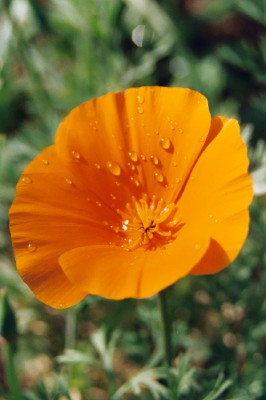
So I thought it's high time I let you know how they all performed. And besides it's a good excuse to post some pretty spring flower photos.
By way of conclusion: they've all flowered at the end of the stated flowering times (i.e. if it said on the label "Flowers from Feb-April" they started in April) - but they've all, amazingly, flowered.
This is so what I'm going to do next year as well. I do love a good bargain!
Tuesday, April 06, 2010
Gardening on air #4: Of Austen and arcadia
No, I didn't either: but a rather wonderful programme about him in the series 'Escape to the Country', about people who make the transition from city to countryside, had me scurrying to my dog-eared edition of Ms Austen's book to check. It's true - it's the bit in chapter 6 where they're talking about Sotherton Hall:
"It wants improvement, ma'am, beyond anything. I never saw a place that wanted so much improvement in my life; and it is so forlorn that I do not know what can be done with it."
"No wonder that Mr. Rushworth should think so at present," said Mrs. Grant to Mrs. Norris, with a smile; "but depend upon it, Sotherton will have every improvement in time which his heart can desire."
"I must try to do something with it," said Mr. Rushworth, "but I do not know what. I hope I shall have some good friend to help me."
"Your best friend upon such an occasion," said Miss Bertram calmly, "would be Mr. Repton, I imagine."
"That is what I was thinking of. As he has done so well by Smith, I think I had better have him at once. His terms are five guineas a day."
The first programme in the series was all about Mr Repton and his five-guinea-a-day designs. It's presented by Laurence Llewellyn-Bowen, who I have until now chiefly associated with wafting around Chelsea in very large cuffs, but clearly I've been doing him an injustice.
Humphry Repton was the one responsible for places like Tatton Park, Longleat Park, Woburn and Kenwood House. He was the one after Capability: Llewelyn-Bowen describes him as the 'feminine' to Capability Brown's 'masculine'. (He also describes him, with I hope a deliberately tongue-in-cheek irony, as 'a makeover artist'). And in a very real sense he took up the reins from Brown, beginning his landscaping career at a time when Capability Brown bestrode the landscape and indeed was largely shaping it.
Repton was all serpentine paths, terraces, balustrades and topiary, often plonking them right in the middle of Capability landscapes in an expensive 18th-century exercise in nose-thumbing. He didn't do what Capability did and sweep away any villages and pesky peasants who got in the way of the grand vision: though what Repton did wasn't much better, as he framed them as part of his presentation of a kind of bucolic Arcadia to be viewed from the terraces of the big house.
The main bit about Repton which stuck in my memory from garden history lessons is also mentioned here: he drew his gardens in beautifully-painted watercolours in red books which he then gave to his clients: the early precursor to a Vectorworks printout, perhaps.
You can listen to this edition of Escape to the Country until next Sunday by the miracle of Listen Again: it's here.
Friday, April 02, 2010
Plant envy
Isn't it beautiful? It is, of course, the dog's tooth violet, Erythronium dens-canis, and I am spitting mad.The reason I'm so bloody furious is that I can't grow the damn thing. Never have been able to. I must have wasted twenty quid over the years on buying its funny-looking bulbs and though I have planted them by the book - partial shade, moist but well-drained, lots of leafmould - they stubbornly refuse to do their stuff. Yet here they were: a little clump, nestling among the spring bulbs on the rockery. And she hadn't even really done much other than plonk them in there. When told of my incredulity at the ease with which they sprang up she just said, "Really? I've never had any trouble."
Why do gardeners always say that?
Dog's tooth violets are not the only thing I can't grow. There's quite a long list, actually.
- snowdrops (going to try the elwesii types at some point though -you never know)
- chillies (this year's failed to germinate, again)
- trilliums (but I'm in good company)
- heliotrope: how do you overwinter them?
- Nicotiana sylvestris: germinate beautifully and then sulk, permanently
- morning glory: ditto (going to try sowing in late May this year)
Wednesday, March 31, 2010
Monday, March 29, 2010
Postcard from Borneo #7: Of the rarest plant of all
Rafflesia keithii (I think): one of the 17 known species of this parasitic flower which appears, without leaves or stems, from the roots of the liana vine. This is something of a holy grail for enthusiastic plant-hunters: so I'm feeling very, very privileged.
This was the only one flowering in Sabah, around the area of Poring Springs near Mt Kinabalu where there's one of the highest concentrations of these extremely rare plants: private garden owners make rich pickings when the flowers appear, but since it's not possible to transplant them or grow them from seed you have to be very, very lucky to have one appear in your garden. A bit like winning the botanical lottery.
They stink. There's no way of getting around it: Capt WE Johns, in his eminent tome 'Biggles in Borneo', refers to it as smelling of 'death and corruption'. Exactly so. Just think forgotten packet of mince left in the back of the fridge for a month or so.
It's pollinated by flies, of course: nothing with such a foul smell could be anything else.
The flowers start as swellings appearing like toadstools from the ground. It can take one of these swellings between 9 and 12 months to reach flowering stage (and not all of them get there): and then the flower lasts one week before it dies.
Did you ever see anything so redolent of putrefaction in your life?
Sunday, March 28, 2010
Postcard from Borneo #6: Of birds, buttresses and butterflies
Mangrove trees along the river
And some wonderfully mossy buttresses in the rainforest.
The trees were incredible: this one was a strangler fig. There was once another, live tree in the centre of this tower of trunks.
And some were so huge they made Californian redwoods look feeble.
Butterflies.... well, they were just everywhere.


(we took ages wondering what this lot were so excited about: was it that bit of brightly-coloured plastic? Or something rather more yucky? We decided probably the latter, so didn't go and investigate).
And not forgetting the birds....

Did you know that birds can't see at night? So if, as happened in this case, you chance upon a snoozing kingfisher by the riverbank, it will freeze and hope you don't see it rather than fly off since it's worried it might fly into something. We could have reached out and picked this one off the branch above our heads: it would have just about fitted into the palm of my hand.
Saturday, March 27, 2010
Postcard from Borneo #5: Of plants that eat animals
Nepenthes, as they should more properly be known, are something of a Borneo speciality. There are 32 known varieties on the island: many are found nowhere else on earth.
In case you've been hiding your head under a pile of sand for the last decade or so, pitcher plants are famous for 'eating' live creatures. Those quotation marks are advised: actually what they do is dissolve flies, insects and anything up to a small mouse in digestive juices held in those curious jug-like bladders. They may be ghoulish but there's a certain fascination about them: and maybe even beauty. They do also flower (safely high above where the pitchers grow, so beneficial pollinating insects aren't accidentally eaten by their host).
I wasn't visiting Borneo at the best time to see pitchers, as the dry season was well set in and most of them had dried into brown, papery husks: but there were a few spectacular specimens about which gave me just a glimpse of what might be out there.
Nepenthes ampullaria
...and again
... and an unknown variety, possibly another N. burbidgeae but mis-labelled as N. rajah - the largest pitcher plant in Borneo and one I'd dearly love to see (about four times the size of this one). I didn't have a chance to root around for any other labels as I was a little preoccupied in preventing the Chinese lady next to me throwing stones in to this one's mouth to see if she could make it close. I gave her a very polite lecture on the habits of pitcher plants and the difference between them and Venus flytraps, and she was rather touchingly grateful and thereafter assumed I was a tour guide. She was very smiley, though obviously habitually misguided.
Friday, March 26, 2010
Postcard from Borneo #4: Of orchids


(Actually I do know what this one is. It's the Rothschild Slipper Orchid (Paphiopedilum rothschildianum): phenomenally rare, and flowering its heart out just for us.) Thursday, March 25, 2010
Postcard from Borneo #3: Monkey business
Long-tailed macaques (I won't mention what these two were up to five seconds before this photo was taken)
Awwww.......
Yes, it is. Six feet long and only 'mildly' venomous. These mangrove snakes were not only hanging over our heads in trees in a mildly terrifying way but also slithering around among our riverside huts. Oh yes, and there were pythons too. And crocodiles in the river.
Chameleon trying to look inconspicuous at Poring Hot Springs.
And this, of course, was what we were all there for (well, that and in my case, the rare plants). Orang-utans have now lost 80% of their natural habitat and are increasingly confined, as this one was, to rehabilitation centres like the one at Sepilok. Wednesday, March 24, 2010
Postcard from Borneo #2: Of forest flowers
At Poring Hot Springs (and they were, very hot) halfway up the mountain, there were lots of these gorgeous things: blowed if I know what they are though...
Wild datura trees on top of a hill
Hibiscus growing on the same hill: a possible garden escapee, I thought
A wierd and wonderful ginger flower bud; this one in the Rainforest Discovery Centre near Sandakan
One man's weed..... Morning glory is the Borneo equivalent of bindweed. Wish I had that problem.
Tuesday, March 23, 2010
Postcard from Borneo #1: Of mountains and jungles
Since there is, unsurprisingly and rather refreshingly, no internet access in the jungle, I thought I'd follow the time-honoured tradition of only sending your postcards once you've arrived home and hoping nobody notices the postmark.
Mount Kinabalu, just outside the capital, Kota Kinabalu and the view that dominated the first half of the week.
Wednesday, March 10, 2010
Saturday, March 06, 2010
Moving matters #4: Things ain't what they used to be
Things are getting a little panicky at home as we've started getting people offering actual money for our house and this has made us realise that when you sell the house from under your feet you aren't allowed to live in it any more.
This means you have to find another house to live in. Quite quickly.
So I began my odyssey around the south-east of England - more specifically, my home county of West Sussex - to work my way through the "hmmm.... maybe" houses we've gathered in our long, long spell of whimsical drifting around internet house-hunting sites. Mostly drive-bys to check out gardens + locations, though I did go inside a couple of them.
This made me realise that houses, and more to the point gardens, have shrunk in the eight years since I last did this. And West Sussex is all but unrecognisable from my admittedly nostalgia-tinged memories of a rather idyllic childhood spent riding ponies around the South Downs.
First, most of the area from Arundel to Petworth to Chichester to Rowland's Castle - that's much of the south-east of England - has been paved over while I wasn't looking.
Second, the bits that are not paved over are eye-wateringly expensive.
So here's what house-hunting is like in our credit-crunched topsy-turvy times:
House 1 was right on the high street of an extremely busy (but quite pleasant, if you didn't have to open your front door onto it every day) country town. Didn't stop long enough to see the garden or I would have caused a traffic jam right in the middle of the Saturday shopping crowd.
House 2 was said on the estate agent's particulars to be "a plot of 0.7 acres". Sounds good, doesn't it? Until you realise that a) the estate agent clearly has his acres confused with square metres, and b) about 0.6 of the 0.7 is house.
House 3 was the only one I saw all day which was in a location I would have lived in. Stunning views across the countryside, pretty village, primary school, nice neighbours.... The garden was quite manicured in an uptight sort of way (pampas grass, trimmed euonymus, spiky things in tubs) but not too unpleasant - only trouble was the estate agents' blurb hinted there was much more of it than appeared to be the case. Though I might have got the boundaries wrong. Another major setback was that the house was more akin to a beach hut.
House 4: in such a nightmare location I couldn't stop without causing a pile-up (I was going 50mph at the time like the three lanes of traffic beside me and only just glimpsed it out of the corner of my eye).
House 5 was a pretty little bungalow - normally I'm very biased against bungalows but this one was gorgeous, all hung with creeper and cottage garden. Like many streets where bungalows are found the neighbours scored quite high in the blue rinse stakes but at least it was peaceful. Quite keen on this one until I got home and found it had already been sold.
House 6 had a fantastic garden with quite the biggest greenhouse I've ever seen in a domestic setting. It stretched from one side of the garden to the other - that's about 40 feet - and there was a second (more normal-sized) greenhouse as well. If I tell you that even with both greenhouses and a summer house there was still loads of garden left you'll realise what a covetable space it was. Only trouble was that you'd have an audience for every spadeful you dug: there were no fewer than five houses backing onto one side, and two backing onto the end. Talk about gardening in a goldfish bowl.
House 7: why do people choose to live in places where you get mashed to a pulp by speeding motorcars on taking more than two steps from your front door?
House 8: the chavs over the road were doing something so complicated to their souped-up car (spoilers plus decals) that they had to play VERY LOUD MUSIC to get the screws to loosen off. I'd have my screws loose living opposite that lot for long. It was a shame really as this one had a huge garden with a pony paddock in the bottom too: mind you the chav music was almost - but not quite - drowned out by the relentless howl of combustion engines from the not-very-far-away A3.
Conclusion from the day: we can't afford to live here.
Thursday, March 04, 2010
Plant of the month: March

Like jewels warmed by the sunshine, the crocuses are waking up.
I have many in my garden: deep purple and profligate Crocus tommasinianus, purest yellow C. chrysanthus, pale violet hybrids of uncertain descent.
But the most beautiful crocus in my garden is one which I only planted for the first time last year, despite many years of coveting its silky white blooms. I now wouldn't be without it.
C. chrysanthus 'Snow Bunting' was bred by the legendary E. A. Bowles, who was something of a crocus buff in his time and produced about 14 hybrids, all named after birds. Most can be found in the National Collection, held at Myddleton House in Enfield.
I have a dozen 'Snow Bunting' in a deep blue ceramic container just outside my back door, rather fancifully planted with some dark bruise-coloured pansies in a vague sort of black-and-white concoction.
Never mind the cliché: it looks utterly fabulous and has me smiling every time I walk out the door. Even when the sun isn't out (i.e. most of the time) the crocuses still look elegant with threads of purple running up the outsides of their closed buds.
But the other morning, the sun came out and hit them full on. I think the only things more excited about it than me were the bees: they couldn't get enough of those joyous butter-yellow throats. And nor could I. The scent filled the air - I've always had to get down on my hands and knees for that exquisite perfume before, but not this time.
It's moments like this that spring was invented for.
Tuesday, March 02, 2010
Meet my baby
Isn't she sweet? Actually she's one of three - triplets, you might say - and I've had them all tucked up in pots over winter on my herb shelf, which is up against the house wall outside so quite a sheltered little spot.The reason I'm so chuffed with my babies making it through winter is that they're Erygium agavifolium, a plant I have admired in other people's gardens for many years. It's a very spectacular and somewhat exotic-looking eryngium, sometimes known as the button eryngium; like most sea-hollies it has bracted rather thistle-like flowerheads, but in this case they're 6ft tall and come in huge ghost-white clusters. The plant is also evergreen with imposing and I hope you'll agree rather attractive rosettes of glossy mid-green toothed leaves. It's borderline hardy - which is why I put the littlies up by the house.
More to the point, these particular ones were free. I spotted a forlorn single remaining specimen while I was at West Dean Gardens near Chichester last year and pounced on it (slightly manically but I don't think anyone noticed). Imagine my glee when I realised that nestled under the main crown were three little babies. Not a word did I utter to the nice lady at the checkout: I paid for one plant and got four. Of such stuff are gardeners' dreams made.
Once home I split the whole lot up, potted up the babies and popped mum in the border by the pond, where she's looking a little battered after this awful winter but still healthy (rather giving the lie to the minus-five minimum temperature usually given for these plants: as usual I think it's the wet rather than the cold that you've got to watch out for). Now I'm looking forward to a fourfold display of spectacular ghostly fireworks this summer. There will be photographs.